Do you know what Email Security is and how XDR can help enhance your security related to your emails for better protection? If not, then you are at the right place. Here, we will talk about what email security is and the related benefits in detail.
Moreover, we will introduce you to a reliable XDR security solution offered by a reputable VAPT service provider. What are we waiting for? Let’s get started!
What Is Email Security?
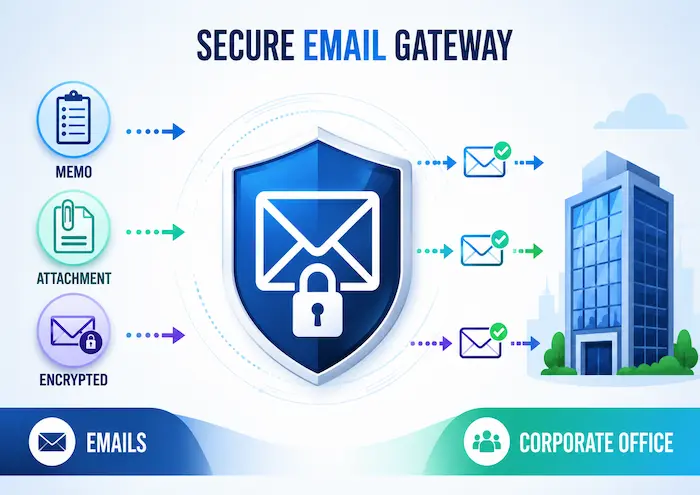
The technical tools, operational guidelines, and user behaviors used to safeguard company email accounts, information, and communications against cyber threats and illegal access are together referred to as email security.
It focuses on stopping harmful incoming traffic, including spoofing, ransomware, phishing, and business email compromise, while keeping private company information from being unlawfully removed from the network.
Email security guarantees organizational privacy, regulatory compliance, and ongoing company operations by protecting email gateways and user inboxes. Let’s take a look at what Email Security is, its uses, its benefits, and how XDR can improve the chances of security against online threats!
Why Is Email Security Critical for Modern Businesses?
|
S.No. |
Factors |
Why? |
|
1. |
Mitigates the Primary Attack Vector |
Stops attackers from using the main entry point for malware, ransomware, and credential theft. |
|
2. |
Prevents Catastrophic Financial Losses |
Prevents direct financial theft from wire fraud, business email compromise, and expensive threat cleanup. |
|
3. |
Protects Proprietary Data and Customer Privacy |
Prevents unlawful data exfiltration, protecting personally identifiable information and trade secrets. |
|
4. |
Ensures Legal and Regulatory Compliance |
Complies with stringent data protection regulations, such as GDPR, HIPAA, and PCI-DSS, to prevent harsh legal penalties. |
|
5. |
Safeguards Operational Continuity and Brand Reputation |
Keeps customers' trust and brand integrity intact while preventing devastating business interruption. |
Common Email Security Threats You Should Know
The following are some common email security threats that you should know about:
1. Phishing & Spear Phishing: Misleading emails intended to fool recipients into disclosing sensitive personal data or login passwords.
2. Business Email Compromise (BEC): Fraudulent wire transfers are authorized by social engineering attacks that pose as executives or merchants.
3. Malware & Ransomware Attachments: Downloads of malicious files that infect host systems to encrypt files for ransom or steal data.
4. Domain Spoofing & Impersonation: Fake email headers designed to trick recipients by imitating authentic firm domains.
5. Account Takeover (ATO): Unauthorized use of a valid email address to conduct clandestine inside attacks.
How Traditional Email Security Solutions Fall Short?
Traditional email security solutions fall short in the following ways:
● Blind to Cross-Domain Threat Context: Detects multi-stage assaults by operating in isolated silos without access to endpoint, network, or cloud telemetry.
● Vulnerable to Advanced Social Engineering: Mainly relies on signature matching and static blacklists, omitting context-based impersonation and text-only phishing.
● Slow Remediation Capabilities: Security personnel must manually find, examine, and remove malicious emails from inboxes due to the lack of automated response capabilities.
● Bypassed by Evolving Evasive Techniques: Fails to identify contemporary attack vectors such as hosted dynamic links, zero-day payloads, and obfuscated URL redirection.
● Inability to Stop Post-Delivery Threats: Loses control over malicious emails once they are delivered, leaving inboxes vulnerable in the event that a seemingly innocuous link turns into a weapon.
What Is Extended Detection and Response (XDR)?
A security platform called Extended Detection and Response (XDR) automatically gathers, correlates, and evaluates threat data from various security layers, such as endpoints, networks, cloud workloads, and email gateways.
XDR provides security teams with unified visibility, early detection of sophisticated multi-stage threats, and automation of response activities throughout the whole IT ecosystem by dismantling telemetry silos.
How Does XDR Strengthen Email Security?
XDR strengthens email security in the following ways:
a) Cross-Domain Telemetry Correlation: Identifies intricate, multi-phase cyberattacks by correlating email signals with endpoint, network, and cloud telemetry.
b) Automated Multi-Vector Containment: Removes hacked credentials, isolates vulnerable endpoints in real time, and simultaneously removes malicious emails.
c) Dynamic Post-Delivery Threat Hunting: Scans delivered inboxes continuously and immediately removes messages if contained files or links are later used as weapons.
d) Accelerated Root Cause Analysis (RCA): Reconstructs the complete attack chain on a single timeline, starting with the original phishing entry and ending with endpoint execution.
e) Shared Ecosystem Threat Intelligence: Automatically blocks incoming email threats throughout the whole company using threat indicators found on endpoints or networks.
Key Features of XDR in Email Security
The following are some key features of XDR in email security:
1. Cross-Vector Threat Correlation: Reveals hidden multi-stage assaults by linking suspicious email signals with network and endpoint activities.
2. Automated Post-Delivery Retraction: When dynamic threats become a weapon, it automatically searches and removes malicious messages from every user's inbox.
3. Orchestrated Incident Playbooks: Initiates automatic containment processes that instantaneously lock compromised accounts and isolate endpoints throughout the company.
4. Unified Root Cause Timeline: Shows the entire assault path in a single view, from the first email delivery to lateral network movement.
5. Centralized Threat Hunting: Allows security teams to query network and cloud logs as well as email telemetry from a single, integrated console.
Benefits of Integrating XDR with Email Security
|
S.No. |
Benefits |
How? |
|
1. |
Eliminates Security Silos |
Combines cloud, network, and endpoint data with email telemetry to provide full cross-domain visibility. |
|
2. |
Drastically Reduces Response Times (MTTR) |
Eliminates threats in seconds as opposed to days by automating threat identification and containment processes. |
|
3. |
Prevents Lateral Movement |
Automatically removes hacked credentials and isolates affected hosts before attackers spread throughout the network. |
|
4. |
Stops Post-Delivery Threats |
Keeps an eye on delivered inboxes to automatically remove messages that become weapons after they get past preliminary defenses. |
|
5. |
Lowers Operational Noise and Fatigue |
To avoid analyst burnout, various low-level alarms are correlated into a single, prioritized incident story. |
Signs Your Organization Needs XDR for Email Security
The following are some signs that your organization needs XDR for email security:
● High Volume of Uncorrelated Alerts: Disconnected email, endpoint, and network notifications that lack context overload analysts.
● Persistent Post-Delivery Weaponization: Phishing emails frequently get past the first gateway screening and use user inboxes as weapons without being noticed.
● Slow Incident Response (High MTTR): Threats might linger for days due to containment delays caused by manual triage and cross-team collaboration.
● Frequent Account Takeovers (ATO): Attackers frequently conduct internal spear-phishing attacks by compromising real organizational credentials.
● Cross-Domain Blind Spots: Security teams are unable to track how a malicious link in an email causes lateral network movement and endpoint execution.
Industries That Benefit Most from XDR-Based Email Security
The following industries benefit most from XDR-based email security:
a) Financial Services & Banking: Protects valuable targets against wire fraud, sophisticated Business Email Compromise (BEC), and regulatory data breaches.
b) Healthcare & Life Sciences: Keeps vital patient information (PHI) safe and stops ransomware assaults from disrupting vital systems.
c) Government & Public Sector: Protects defense networks and key public infrastructure from state-sponsored espionage and phishing efforts.
d) Retail, E-Commerce, & Supply Chain: Protects intricate vendor communication networks from credential harvesting and payment scam impersonations.
e) Technology & SaaS Enterprises: Protects customer cloud environments against supply-chain assaults and protects proprietary intellectual property.
How to Choose the Right XDR Solution for Email Security?
|
S.No. |
Factors |
How? |
|
1. |
Native Cross-Domain Integration |
Guarantees smooth telemetry sharing throughout the network, cloud, email, and endpoint layers. |
|
2. |
Automated Containment and Playbooks |
Provides pre-made, automated workflows to quickly remove fraudulent emails and isolate infected hosts. |
|
3. |
Advanced Post-Delivery Protection |
Keeps an eye on delivered inboxes to automatically remove texts that become weapons after delivery. |
|
4. |
Low Noise and High-Precision Correlation |
To avoid analyst fatigue, raw alerts are grouped into high-fidelity, prioritized incident reports. |
|
5. |
Scalability and Ecosystem Openness |
Allows for smooth API integrations with current enterprise technologies while expanding to accommodate increasing workloads. |
Email Security Best Practices Alongside XDR
The following are some email security best practices alongside XDR:
1. Enforce Authentication Protocols (SPF, DKIM, DMARC): Verify the legitimacy of the sender and stop domain spoofing before harmful emails get to users' inboxes.
2. Mandate Multi-Factor Authentication (MFA) & Least Privilege: Limit internal lateral movement and prevent account takeover attempts with secure user access.
3. Conduct Continuous Phishing Awareness Training: Employees can develop a watchful human firewall by participating in frequent simulated phishing exercises.
4. Deploy AI-Powered Email Hygiene Filters: Use dynamic sandboxing to filter incoming content for malicious attachments, weaponized links, and zero-day threats.
5. Implement Strict Data Loss Prevention (DLP) Policies: To avoid unintentional leaks or unwanted exfiltration of sensitive data, keep an eye on and limit outbound email traffic.
Conclusion: Strengthen Your Email Security with XDR Today
Now that we have talked about what Email Security is, you might want to protect yourself from such attacks and get a dedicated security solution. For that, you can go for ShieldXDR, a dedicated threat detection and response tool offered by Craw Security.
ShieldXDR can automatically detect any suspicious activity over your networks and systems to alert you beforehand and respond to the attacks to protect yourself. Thus, you will be able to feel secure working in your work environment. What are you waiting for? Contact, Now!
Frequently Asked Questions
About Email Security and XDR
1. What is email security, and why is it important?
In order to prevent data breaches, financial loss, and unauthorized network access, email security is comprised of the technical controls, policies, and procedures used to safeguard email accounts and communications from cyber threats.
2. How does XDR improve email security?
XDR improves email security in the following ways:
a) Cross-Domain Threat Correlation,
b) Automated Multi-Vector Containment,
c) Dynamic Post-Delivery Threat Retraction,
d) Unified Root Cause Analysis (RCA), and
e) Shared Ecosystem Threat Intelligence.
3. What are the most common email security threats?
The following are the most common email security threats:
a) Phishing & Spear Phishing (including QR Code Phishing),
b) Business Email Compromise (BEC),
c) Malware & Ransomware Attachments,
d) Domain Spoofing & Impersonation, and
e) Account Takeover (ATO).
4. Can XDR detect phishing and Business Email Compromise (BEC) attacks?
In order to identify fake senders, dynamic URL threats, and odd communication patterns in real time, XDR correlates email signals with identity, endpoint, and behavioral telemetry to detect phishing and BEC assaults.
5. What is the difference between XDR and traditional email security solutions?
While XDR integrates email telemetry with endpoint, network, and identity data to detect and automatically contain multi-stage intrusions throughout the whole ecosystem, traditional email security examines incoming messages in isolation.
6. How does XDR identify malicious email attachments and links?
XDR identifies malicious email attachments and links in the following ways:
a) Dynamic Sandboxing & Behavioral Analysis,
b) Cross-Domain Telemetry Correlation,
c) Time-of-Click URL Analysis,
d) AI & Computer Vision Detection, and
e) Global Threat Intelligence Feed Integration.
7. Can XDR integrate with Microsoft 365 and Google Workspace?
In order to gather data, correlate cross-domain threats, and carry out automatic response activities across email and cloud environments, XDR platforms do indeed directly interact with Google Workspace and Microsoft 365 through APIs.
8. Is XDR suitable for small and medium-sized businesses (SMBs)?
When implemented as a Managed XDR (MXDR) or cloud-native solution, XDR can provide enterprise-grade cross-domain protection and automatic containment to smaller security teams without requiring a big SOC staff.
9. What are the key benefits of implementing XDR for email security?
The following are the key benefits of implementing XDR for email security:
a) Cross-Vector Threat Correlation,
b) Automated & Instant Response,
c) Dynamic Post-Delivery Remediation,
d) Streamlined Root Cause Analysis, and
e) Reduced SOC Fatigue.
10. How can organizations strengthen their email security strategy with XDR?
Organizations can strengthen their email security strategy with XDR in the following ways:
a) Establish Unified Cross-Domain Telemetry,
b) Deploy Automated Remediation Playbooks,
c) Implement Dynamic Post-Delivery Retraction,
d) Integrate Identity-Centric Behavioral Analytics, and
e) Establish Continuous Threat Intelligence Sharing.