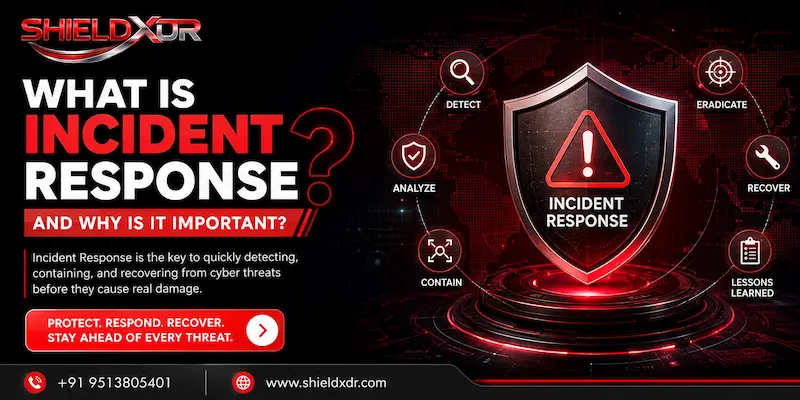
Do you know what Incident Response is and why it is so important for businesses against online threats? If not, then you are at the right place. Here, we will talk about what incident response is and the related benefits for users in detail.
Moreover, we will introduce you to a reliable XDR solution offered by a reputable VAPT service provider. What are we waiting for? Let’s get started!
What Is Incident Response in Cybersecurity?
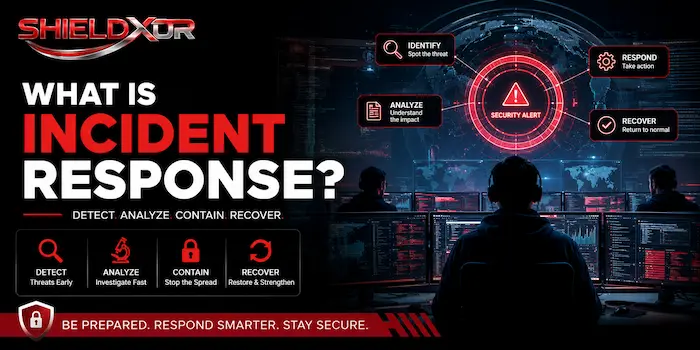
Organizations utilize incident response, an organized cybersecurity method, to anticipate, identify, contain, and recover from security breaches and assaults. Its main goals are to minimize operational harm, stop lateral threat movement, and swiftly return impacted systems to a secure state.
Security teams can prevent similar security problems by strengthening future defenses and updating response processes through the analysis of post-incident data. Let’s take a look at what Incident Response is and related benefits for the protection of your business against online threats!
Why Is Incident Response Important for Business Security?
Incident response is important for business security for the following reasons:
1. Minimizes Financial Losses and Business Downtime: Swift containment limits operational disturbance, preventing costly downtime, ransom payments, and lost income.
2. Protects Sensitive Data and Intellectual Property: Threat actors are prevented from stealing proprietary assets or private client data by rapid isolation.
3. Ensures Legal and Regulatory Compliance: Demonstrates due precaution to avoid severe fines by complying with mandated breach notification legislation such as GDPR, HIPAA, and PCI-DSS.
4. Preserves Brand Reputation and Customer Trust: Clear and effective incident containment reduces negative publicity and preserves client trust.
5. Strengthens Long-Term Security Posture: Future defense tactics are directly informed by post-incident studies that uncover underlying vulnerability root causes.
Benefits of an Effective Incident Response Plan
|
S.No. |
Benefits |
How? |
|
1. |
Accelerates Threat Detection and Containment |
Allows for quick threat recognition and isolation, halting lateral movement before extensive harm is done. |
|
2. |
Reduces Financial Impact and Recovery Costs |
Reduces requests for extortion, expensive emergency remediation costs, and operational downtime. |
|
3. |
Maintains Regulatory Compliance |
Reduces legal liabilities and regulatory fines by meeting required breach reporting deadlines. |
|
4. |
Protects Critical Data and Business Assets |
Prevents client records and sensitive intellectual property from being destroyed or unlawfully exfiltrated. |
|
5. |
Improves Organizational Resilience |
Converts lessons learned from the event into practical defense improvements to fend off cyberattacks in the future. |
Common Types of Cybersecurity Incidents
The following are some common types of cybersecurity incidents:
● Ransomware & Malware Outbreaks: To interfere with corporate operations, malicious software encrypts important files or propagates independently via network systems.
● Phishing & Social Engineering: Employees are tricked into disclosing private login information or carrying out malicious payloads by deceptive emails, calls, or messages.
● Distributed Denial of Service (DDoS) Attacks: To stop internet services, flood servers or network infrastructure with excessive amounts of garbage traffic.
● Unauthorized Access & Credential Compromise: Threat actors compromise internal company accounts through brute-force assaults, session hijacking, and password theft.
● Data Breaches & Exfiltration: Adversaries surreptitiously obtain and steal confidential business records, customer PII, and proprietary intellectual property.
Preparation and Incident Response Planning
You can plan and prepare for incident response in the following ways:
a) Establish a Multi-Disciplinary IR Team: Define clear roles across IT, legal, HR, and PR to ensure speedy, coordinated decision-making during a crisis.
b) Develop and Document Formal Playbooks: Create step-by-step protocols targeted to certain attack types, including ransomware, phishing, and data breaches.
c) Deploy Essential Monitoring and Security Tools: Use network traffic logging, SIEM, and EDR systems to guarantee ongoing visibility and quick threat identification.
d) Implement Rigorous Backup and Restoration Strategies: To ensure full system recovery without having to pay ransoms, keep unchangeable, offline backups that are regularly tested.
e) Conduct Regular Tabletop Exercises and Simulations: Run realistic attack scenarios with key stakeholders to discover operational weaknesses and refine response preparation.
Threat Detection and Security Incident Identification
Using tools like SIEM and EDR to continuously monitor systems, networks, and logs in order to identify known attack patterns or aberrant behavior is known as threat detection and security incident identification.
After that, security experts prioritize these notifications in order to verify that the breaches are real, assess their extent, and initiate containment strategies before the damage gets worse.
Incident Containment and Damage Reduction
In order to stop an attack's lateral propagation, incident containment focuses on isolating affected hosts, canceling compromised credentials, and blocking malicious IP connections. In addition to preventing data exfiltration and minimizing operational disturbance, rapid containment protects vital forensic evidence for post-incident investigation.
Threat Eradication and System Recovery
To guarantee total enemy eviction, threat eradication entails eliminating all traces of malware, rogue accounts, and backdoors from compromised environments. Before putting infrastructure back into production, system recovery uses clean backups to safely restore operations, applies security fixes, and verifies system integrity.
Post-Incident Analysis and Lessons Learned
The response team gathers for post-incident analysis to assess operational bottlenecks, timetable accuracy, and underlying reasons for the most recent breach. To stop similar attacks in the future, these insights are transformed into practical improvements for security controls, detection rules, and incident response playbooks.
Building an Incident Response Team (CSIRT Roles & Responsibilities)
You can build an incident response team in the following ways:
1. Incident Commander (IR Lead): Overall incident strategy is directed, team processes are coordinated, and high-level containment choices are made during a crisis.
2. Lead Technical Analysts & Forensics Experts: Examine affected systems, retrieve malware artifacts, look into the underlying reasons, and carry out technical containment.
3. Communication & PR Liaison: Regulates public comments and oversees internal revisions to uphold media accuracy and customer confidence.
4. Legal Counsel & Compliance Advisor: Oversees breach notification timelines, makes sure response measures follow privacy rules, and deals with law enforcement involvement.
5. Executive Sponsor & Management Representative: Allows high-impact operational shutdowns, authorizes the use of emergency resources, and ensures that reaction choices are in line with business risks.
The Role of Automation and SOAR in Incident Response
The following are the roles of automation and SOAR in incident response:
● Accelerates Alert Triage and Tonal Noise Reduction: Reduces analyst fatigue by automatically filtering false positives and correlating high-priority security alarms.
● Executes Automated Response Playbooks: Revokes compromised credentials in a matter of seconds, blocks malicious IPs, and instantly isolates compromised hosts.
● Standardizes and Streamlines Incident Workflows: Automates tedious ticketing and task assignments to enforce uniform response procedures among teams.
● Automates Forensic Evidence Collection: Automatically collects system logs, memory dumps, and threat intelligence context when an alarm is triggered.
● Optimizes SOC Operations and Metric Tracking: Monitors important parameters to constantly improve team performance, such as Mean Time to Detect (MTTD) and Respond (MTTR).
Incident Response vs Disaster Recovery
|
S.No. |
Topics |
Factors |
What? |
|
1. |
Incident Response (IR) |
Focus & Scope |
Limits attacker activity and minimizes security impact by addressing current cybersecurity risks and breaches, including ransomware, phishing, and illegal network invasions. |
|
Primary Objective |
Identify, isolate, and remove hostile threat actors while preserving digital evidence and minimizing data exfiltration. |
||
|
2. |
Disaster Recovery (DR) |
Focus & Scope |
Restores servers, data centers, and vital IT infrastructure following severe operational disruptions, such as power outages, hardware malfunctions, or natural disasters. |
|
Primary Objective |
To ensure business continuity, recover systems and data from clean backups in accordance with specified Recovery Time Objectives (RTO) and Recovery Point Objectives (RPO). |
Conclusion: Strengthening Cybersecurity with Incident Response
Now that we have talked about what Incident Response is, you might want to get your hands on a dedicated security tool to respond to cyberattacks. For that, you can go for ShieldXDR, a dedicated threat detection and response tool offered by Craw Security.
Shieldxdr help organizations by automatically detecting cyber threats and responding to them to protect businesses against bigger risks. Thus, you will feel secure while working online. What are you waiting for? Contact, Now!
Frequently Asked Questions
About Incident Response
1. What is incident response in cybersecurity?
In cybersecurity, incident response is an organized operational procedure intended to quickly identify, contain, eliminate, and recover from cyberattacks in order to reduce damage and resume regular company activities.
2. Why is incident response important for organizations?
Incident response is important for organizations for the following reasons:
a) Minimizes Financial and Operational Damage,
b) Protects Sensitive Data Assets,
c) Ensures Legal and Regulatory Compliance,
d) Preserves Customer Trust and Reputation, and
e) Strengthens Future Security Defenses.
3. What are the main stages of the incident response process?
The following are the main stages of the incident response process:
a) Preparation,
b) Detection & Analysis,
c) Containment,
d) Eradication & Recovery, and
e) Post-Incident Activity (Lessons Learned).
4. What is the difference between incident response and disaster recovery?
While disaster recovery focuses on rebuilding IT infrastructure, systems, and data following catastrophic interruptions to resume regular corporate operations, incident response concentrates on recognizing, containing, and eliminating active cyberattacks to cease enemy activity.
5. What types of cyber incidents require an incident response plan?
The following types of cyber incidents require an incident response plan:
a) Ransomware & Malware Outbreaks,
b) Phishing & Social Engineering,
c) Data Breaches & Unapproved Exfiltration,
d) Distributed Denial of Service (DDoS) Attacks, and
e) Unauthorized Network Intrusion & Cloud Misconfigurations.
6. Who should be part of an incident response team?
The following individuals should be part of an incident response team:
a) Incident Commander (IR Lead),
b) Technical Analysts & Forensics Experts,
c) Legal Counsel & Compliance Officer,
d) Public Relations & Communications Liaison, and
e) Executive Sponsor & Management Representative.
7. How does incident response help reduce cyberattack damage?
Incident response helps reduce cyberattack damage in the following ways:
a) Enables Rapid Threat Containment,
b) Minimizes System Downtime,
c) Prevents Data Loss and Theft,
d) Limits Financial and Legal Liabilities, and
e) Protects Brand Reputation.
8. What tools are commonly used in incident response?
The following tools are commonly used in incident response:
a) SIEM (Security Information and Event Management),
b) EDR/XDR (Endpoint Detection and Response),
c) SOAR (Security Orchestration, Automation, and Response),
d) Digital Forensics & Memory Analysis Tools, and
e) Network Analysis & Traffic Monitoring.
9. How often should an incident response plan be updated?
At least once a year, as well as right away after large security events, major infrastructure upgrades, or regulatory revisions, an incident response plan should be evaluated and updated.
10. Can small businesses benefit from incident response planning?
Yes, incident response strategy avoids financial losses, decreases operational downtime, safeguards consumer faith, and maintains legal compliance during a cyberattack, all of which have a substantial positive impact on small firms.