Do you want to know about the Top 10 Cyber Threats XDR Can Detect and get better security measures for your business? If yes, then you are at the right place. Here, we will talk about what kinds of threats XDR can detect and their benefits in detail.
Moreover, we will introduce you to a reliable XDR solution offered by a reputable VAPT service provider. What are we waiting for? Let’s get started!
What Is Extended Detection and Response (XDR)?
Extended Detection and Response (XDR) serves as a unified security platform that consolidates telemetry from endpoints, networks, cloud workloads, and identity systems, offering comprehensive operational visibility.
XDR reveals intricate, multi-phase cyber threats that conventional isolated security tools overlook by automatically correlating data across these various security layers. This allows security operations teams to quickly identify, probe, and carry out automated response measures to limit attacks prior to major harm taking place.
Let’s talk about the Top 10 Cyber Threats XDR Can Detect and how it can be beneficial for our businesses!
XDR vs. Legacy Security Solutions (SIEM, EDR, Antivirus)
|
S.No. |
Topics |
Factors |
What? |
|
1. |
XDR vs. Traditional Antivirus (AV) |
Scope |
While antivirus scans known file signatures on individual endpoints, XDR gathers and correlates telemetry across endpoints, networks, cloud, and identity platforms. |
|
Detection Capability |
While antivirus software fails to detect fileless malware and living-off-the-land attacks, XDR is capable of real-time detection of intricate behavioral anomalies and multi-stage attack chains. |
||
|
2. |
XDR vs. Endpoint Detection & Response (EDR) |
Visibility Depth |
EDR is limited to host-level endpoint activity, while XDR broadens EDR's visibility by incorporating network traffic, email, cloud workloads, and identity logs. |
|
Context & Correlation |
While EDR can overlook attacks that jump between unmanaged devices or cloud environments, XDR links together various signals throughout your entire ecosystem to uncover the full attack path. |
||
|
3. |
XDR vs. Security Information & Event Management (SIEM) |
Actionability vs. Aggregation |
While SIEM serves mainly as a log repository that necessitates extensive manual rule creation, XDR is equipped with automated detection engines and active response mechanisms out of the box. |
|
Deployment & MTTR |
While SIEM platforms frequently generate a large number of unrelated alerts, causing analyst fatigue, XDR automatically consolidates related alerts into single incidents, significantly lowering the Mean Time to Respond (MTTR). |
How does XDR identify and Stops Cyber Threats Before They Escalate?
XDR identifies and stops cyber threats before they escalate in the following ways:
1. Cross-Domain Telemetry Correlation: Brings together signals from endpoints, networks, cloud, and identity systems to reveal concealed attack chains at an early stage.
2. Behavioral Analytics & Anomaly Detection: Utilizes baseline profiling to identify subtle, unauthorized deviations before attackers can reach their objectives.
3. Automated Alert Triage & Root Cause Analysis: Groups consolidate fragmented events into single incidents to immediately show where and how an attack began.
4. Real-Time Automated Response Playbooks: As soon as threats reach threshold levels, carry out immediate containment measures such as isolating the host or revoking tokens.
5. Proactive Threat Hunting & Risk Prioritization: Assigns a priority to critical vulnerabilities and developing vectors, enabling security teams to thwart threats with a high risk level while in progress.
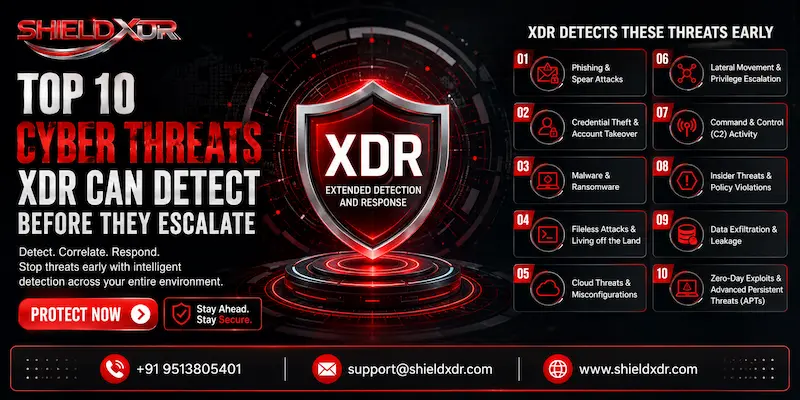
Top 10 Cyber Threats XDR Can Detect Before They Escalate
The following are the top 10 cyber threats XDR can detect before they escalate:
● Phishing and Business Email Compromise (BEC) Attacks: Link email clicks to subsequent changes in endpoint memory or identity anomalies to prevent harmful execution.
● Ransomware Infections: Recognizes attempts at mass file encryption across endpoints and automatically isolates the infected host in real time.
● Malware and Advanced Persistent Threats (APTs): Monitors signs of a multi-stage assault as time goes on, linking small-scale initial attacks to the overall conduct of the campaign.
● Insider Threats and Privilege Misuse: Identifies deviations from baseline user activity, including non-admin accounts performing privileged actions or accessing sensitive files.
● Credential Theft and Account Takeovers: Identifies unauthorized LSASS memory dumps on hosts and prevents simultaneous or impossible location logins.
● Zero-Day Exploits and Unknown Threats: Examines the behavior of applications during runtime and the chains of process creation, as opposed to depending on static signatures.
● Lateral Movement Across the Network: Integrates host telemetry with network traffic monitoring to reveal internal scanning and misuse of protocols such as RDP or SMB.
● Command-and-Control (C2) Communications: Identifies suspicious outbound network connections or beaconing traffic that originates from internal processes.
● Fileless Malware and Living-off-the-Land (LotL) Attacks: Supervises native command line utilities (e.g., PowerShell, WMI) for harmful parameters and unforeseen parent processes.
● Cloud Security Threats and Misconfigurations: Processes cloud audit logs and API calls to identify over-privileged roles, exposed storage, and unauthorized changes to the control plane.
Role of AI and Behavioral Analytics in XDR
|
S.No. |
Roles |
What? |
|
1. |
Dynamic Baseline Profiling |
Identifies subtle anomalies before static rules are triggered by learning standard behaviors of users and devices. |
|
2. |
Detecting "Living off the Land" (LotL) Tactics |
Assesses command intent and process execution to identify the misuse of native admin tools. |
|
3. |
Cross-Domain Correlation & Attack Graphing |
Links together low-level events that are scattered across identity, network, and endpoint logs into a clear timeline of the attack. |
|
4. |
Noise Reduction & High-Fidelity Alert Triage |
Eliminates routine false positives to highlight high-priority, actionable threats for analysts. |
|
5. |
Uncovering Zero-Day & Unknown Threats |
Detects dubious actions during runtime and behavioral trends without depending on established malware signatures. |
Key Features That Enable XDR to Detect Threats Early
The following are key features enabling XDR to detect threats early:
a) Unified Cross-Domain Telemetry: Collects and standardizes real-time data from endpoints, networks, identity systems, and cloud workloads into a unified view.
b) AI & Machine Learning-Driven Behavioral Analytics: Spots minor irregularities through the ongoing comparison of current behaviors of users and devices with established historical norms.
c) Multi-Vector Alert Correlation & Attack Graphing:Stitches together low-fidelity signals from various domains into a clear, consolidated timeline of the complete attack path.
d) MITRE ATT&CK Mapping & Risk Prioritization: Classifies the methods of the attacker as they happen to emphasize the threats that are most urgent.
e) Automated Orchestration & Instant Containment: Immediately activates pre-set playbooks to isolate affected hosts, block IP addresses, or cancel user sessions.
Benefits of Using XDR for Proactive Cyber Threat Detection
The following are the benefits of using XDR for proactive cyber threat detection:
1. Eliminates Blind Spots with Unified Cross-Domain Visibility: Consolidates endpoints, networks, identities, and cloud logs to create a comprehensive security operational picture.
2. Stops Attacks Earlier in the Kill Chain: Identifies initial foothold actions prior to adversaries executing lateral movements or data exfiltration.
3. Drastically Reduces Alert Fatigue: Organizes low-fidelity alerts into incident reports that are prioritized and can be acted upon.
4. Accelerates Response Time Through Automation: Activates immediate containment procedures to eliminate ongoing dangers in mere seconds instead of hours.
5. Reduces Operational Complexity and Tool Sprawl: Brings together various point security tools into one coherent management console.
Real-World Impact & ROI of Early Threat Containment
|
S.No. |
Factors |
What? |
|
1. |
Multi-Million Dollar Cost Avoidance |
Averts huge ransom payments, regulatory penalties, and expensive fees for data breach remediation. |
|
2. |
Minimization of Operational Downtime |
Maintains essential business processes without interruption by preventing attacks before any disruption of systems. |
|
3. |
Preservation of Brand Reputation and Customer Trust |
Protects sensitive customer data to avert public exposure and severe damage to the brand. |
Best Practices to Maximize XDR Effectiveness
The following are the best practices to maximize XDR effectiveness:
● Ingest Comprehensive, High-Fidelity Data Sources: Link telemetry from all endpoints, networks, identities, and cloud workloads to remove blind spots.
● Map Detections to the MITRE ATT&CK Framework: Ensure alerts are in line with acknowledged opponent strategies to enable rapid evaluation of threat development and situation.
● Implement Phased, Safe Response Automation: Begin with auto-containing low-risk threats before activating fully automated playbooks for critical assets.
● Continuously Fine-Tune Correlation Rules and Baselines: Refine ML models and alert thresholds on a regular basis to reduce false positives and adjust to environmental changes.
● Validate Platform Efficacy via Red/ Purple Teaming: Regularly simulate actual attack scenarios to assess detection coverage and optimize response workflows.
Common Mistakes Organizations Make When Deploying XDR
The following are common mistakes organizations make when deploying XDR:
a) Treating XDR as a Plug-and-Play Solution: Anticipating that ready-made software can completely substitute for a clear security strategy, governance, and experienced analysts.
b) Incomplete Data Ingestion: Leaving out all essential telemetry sources, like identity systems or cloud logs, results in perilous blind spots.
c) Enabling Aggressive Automation Without Testing: There is a risk that fully automated response playbooks will disrupt essential business operations if they are deployed too quickly.
d) Overlooking Continuous Fine-Tuning: Failing to regularly update baselines and correlation rules leads to ongoing alert fatigue and false positives.
e) Neglecting Security Team Alignment & Training: Implementing the platform without revising internal SOC playbooks or providing training for analysts on managing cross-domain alerts.
How to Choose the Right XDR Solution for Your Business?
|
S.No. |
Factors |
How? |
|
1. |
Evaluate Native Compatibility vs. Open Integration |
Ascertain which option—single-vendor native integration or vendor-agnostic open-XDR—best aligns with your current security stack. |
|
2. |
Assess Cross-Domain Telemetry Coverage |
Validate that the platform processes real-time data from various endpoints, networks, identities, emails, and cloud environments. |
|
3. |
Verify Behavioral Analytics and AI Capabilities |
Make sure that sophisticated ML models identify zero-day exploits and unknown anomalies that go beyond basic signature matching. |
|
4. |
Test Orchestration and Safe Automation Flexibility |
Playbooks that are confirmed should allow for custom response thresholds and manual overrides by analysts to avoid operational disruption. |
|
5. |
Align with Operational Capabilities (MXDR vs. Self-Managed) |
Make a decision on whether to handle the platform internally or utilize Managed XDR, depending on the internal SOC's capacity. |
Why is ShieldXDR an ideal choice for advanced threat detection?
ShieldXDR is an ideal choice for advanced threat detection for the following reasons:
1. Unified XDR and Built-in DLP Protection: Brings together cross-domain threat monitoring and data loss prevention into one console to prevent unauthorized exfiltration.
2. AI-Powered Behavioral Analytics: Constantly assesses how processes are executed and how users behave to identify zero-day exploits and anomalies.
3. Automated Containment & Fast Response: Initiates immediate response actions based on a playbook to control ongoing security threats in less than 5 minutes.
4. Integrated Dark Web & Threat Intelligence Monitoring: Ingests real-time threat feeds and scans underground forums to detect leaked credentials and targeted risks at an early stage.
5. High-Fidelity Correlation & False-Positive Reduction: Employs cross-surface signal mapping and suppression algorithms to reduce alert noise by as much as 70%.
Conclusion
Now that we have talked about the Top 10 Cyber Threats XDR Can Detect, you might want to get your hands on a dedicated XDR solution for better security. For that, you can go for ShieldXDR, a dedicated threat detection and response tool offered by Craw Security.
ShieldXDR can help organizations detect suspicious activities over their networks and systems and deal with them with ease without human intervention. Thus, you can feel safer while working online. What are you waiting for? Contact, Now!
Frequently Asked Questions
About Top 10 Cyber Threats XDR Can Detect
1. What cyber threats can XDR detect before they become major incidents?
XDR can detect the following cyber threats before they become major incidents:
a) Ransomware & Mass File Encryption,
b) Phishing & Business Email Compromise (BEC),
c) Fileless & "Living off the Land" (LotL) Attacks,
d) Credential Theft & Account Takeovers, and
e) Lateral Movement & Command-and-Control (C2).
2. How does XDR detect ransomware attacks at an early stage?
XDR detects ransomware attacks at an early stage in the following ways:
a) Initial Access & Phishing Tracking,
b) Exploit & Loader Detection,
c) Behavioral File-System Monitoring,
d) Shadow Copy & Recovery Tampering Alerts, and
e) Command-and-Control (C2) Identification.
3. Can XDR identify phishing and business email compromise attacks?
Yes, XDR identifies phishing and BEC attacks by correlating suspicious email links, spoofed sender domains, and unusual login locations with endpoint execution logs.
4. Does XDR detect insider threats and unauthorized user activities?
Yes, XDR identifies insider threats and unauthorized actions by monitoring anomalies in user behavior, privilege escalations, and atypical cross-domain data access in real time.
5. How does XDR prevent lateral movement within a network?
XDR prevents lateral movement within a network in the following ways:
a) Internal Network & Traffic Inspection,
b) Identity & Credential Anomaly Detection,
c) Process & Host Execution Tracking,
d) Cross-Domain Path Graphing, and
e) Automated Isolation & Containment.
6. Can XDR detect zero-day exploits and fileless malware?
Yes, XDR identifies zero-day exploits and fileless malware through AI-driven behavioral analytics that monitor memory anomalies, runtime process executions, and misuse of native tools, rather than depending on static signatures.
7. What is the difference between XDR and traditional antivirus software?
While traditional antivirus software depends on static signatures to prevent known malware on single endpoints, XDR employs AI-driven telemetry for real-time detection, correlation, and response to intricate threats across endpoints, networks, identity systems, and cloud environments.
8. How does XDR improve incident response and threat investigation?
XDR can improve incident response and threat investigations in the following ways:
a) Centralized Cross-Domain Telemetry,
b) Automated Alert Correlation,
c) Accelerated Root-Cause Analysis,
d) One-Click & Automated Containment, and
e) Pre-Built Playbooks & Orchestration.
9. Is XDR suitable for cloud, hybrid, and remote work environments?
Yes, XDR is tailored for cloud, hybrid, and remote work settings as it effortlessly consolidates telemetry from endpoint devices, cloud workloads, identity providers, and network connections, irrespective of their physical locations.
10. What factors should businesses consider when choosing an XDR solution?
Businesses should consider the following factors while choosing an XDR solution:
a) Integration Architecture (Open vs. Native XDR),
b) Cross-Domain Telemetry Scope,
c) Automation & Orchestration Capabilities,
d) Total Cost of Ownership (TCO) & Data Pricing, and