Do you know what Lateral Movement is, its uses, its main target, and how you can protect yourself against such attacks? If not, then you are in the right place. Here, we will talk about what lateral movement is and related prevention techniques in detail.
Moreover, we will introduce you to a reliable security solution offered by a reputable VAPT service provider. What are we waiting for? Let’s get straight to the topic!
What Is Lateral Movement in Cybersecurity?
In cybersecurity, lateral movement describes the methods that attackers employ to continue traveling throughout a network after obtaining initial access. Adversaries penetrate further into the environment to find sensitive data and high-value assets by elevating privileges and gaining access to more systems.
Threat actors can develop persistence, compromise critical infrastructure, and stage covert data exfiltration or extortion thanks to this internal process. Let’s take a look at what Lateral Movement is, its uses, and how you can protect yourself against it!
Why Is Detecting Lateral Movement Important?
|
S.No. |
Factors |
Why? |
|
1. |
Prevents Minor Intrusions from Becoming Full Breach Disasters |
Prevents confined initial access before attackers get to vital business systems and core databases. |
|
2. |
Reduces Attacker Dwell Time |
Shrinks the duration adversaries have to discreetly assess network defenses, elevate privileges, and build permanent backdoors. |
|
3. |
Stops Ransomware and Mass Extortion Before Execution |
Stops ransomware deployment and large-scale data exfiltration by intercepting attackers as they go across systems. |
|
4. |
Exposes Abuse of Legitimate Administrative Credentials |
Detects opponents using living-off-the-land tactics, dual-use admin tools, and stolen credentials. |
|
5. |
Minimizes Operational Downtime and Incident Recovery Costs |
Local threat containment prevents costly remediation, commercial disruption, and wider system isolation. |
Common Lateral Movement Techniques Attackers Use
The following are some common lateral movement techniques attackers use:
1. Pass-the-Hash and Ticket Attacks (T1550): Adversaries can authenticate across neighboring hosts without using plain-text credentials by reusing stolen Kerberos tickets or password hashes.
2. Abuse of Remote Services (T1021): Attackers travel interactively between internal systems by using trustworthy protocols like RDP, SSH, and SMB.
3. Living-off-the-Land Admin Utilities (T1047 / T1021.006): To blend seamlessly with regular administrative traffic, native administrative technologies such as WMI and PowerShell execute tasks remotely.
4. Exploitation of Remote Services (T1210): Threat actors obtain arbitrary code execution on nearby computers by taking advantage of unpatched vulnerabilities in internal network services.
5. Internal Spear-Phishing & Session Hijacking (T1534 / T1563): Internal accounts that have been compromised can take over active user sessions or transmit malicious messages to trusted peers.
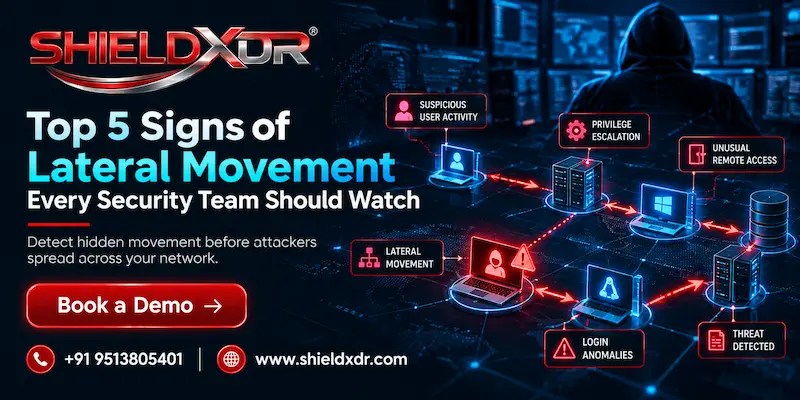
5 Signs of Lateral Movement Security Teams Should Watch
The following are the 5 signs of lateral movement security teams should watch:
● Unusual Remote Logins and Authentication Activity: High-volume off-hours logons, impossible travel logins, or repeated failed authentications followed by surprising success.
● Abnormal Use of Administrative Tools and Protocols: Spikes in the use of non-standard internal endpoints by native administration tools such as PowerShell, WMI, or PsExec.
● Sudden Privilege Escalation or Account Changes: Unexpected service ticket requests, local backdoor account creation, or unforeseen domain admin rights assignments.
● Unusual Network Connections Between Internal Hosts: Unexpected port scanning, unusual workstation-to-workstation activity, or direct SMB/RDP connections between segments.
● Suspicious Credential Access or Reuse: LSASS process memory dumping, unexpected access to Domain Controllers, or identical password hashes authenticating across many hosts simultaneously.
How to Detect Lateral Movement in Your Network?
|
S.No. |
Factors |
How? |
|
1. |
Monitor Authentication Logs for Behavioral Anomalies |
Keep an eye on domain controller logs for spikes in off-peak access, uncommon Kerberos ticket requests, and concurrent logins. |
|
2. |
Inspect East-West Network Traffic |
To find unexpected RDP, SSH, and SMB connections between workstations, examine internal network telemetry. |
|
3. |
Audit Native Administrative Tool Execution |
Enforce process monitoring and command-line logging to identify questionable PowerShell, WMI, and PsExec usage. |
|
4. |
Detect Credential Harvesting and Memory Abuse |
Use endpoint rules to keep an eye on token manipulation, SAM registry hive dumps, and LSASS memory access. |
|
5. |
Correlate Telemetry with Threat Intelligence and MITRE ATT&CK |
To find concealed intrusions, compare endpoint, network, and identity events to known threat actor behavioral patterns. |
How to Respond to Suspected Lateral Movement?
You can respond to suspected lateral movement in the following ways:
a) Isolate Compromised Endpoints Immediately: To stop more east-west traversal without shutting down the impacted machines, sever their active network interfaces.
b) Revoke Stolen Credentials and Reset Kerberos Tokens: Reset compromised domain accounts, invalidate active user sessions, and change the password for the KRBTGT account twice.
c) Identify and Terminate Malicious Processes: Eliminate malicious persistence methods, rogue PowerShell scripts, and unauthorized remote administrative sessions.
d) Block Malicious Internal IP Addresses and Ports: To limit RDP, SMB, and WinRM traffic over non-essential network segments, implement temporary internal firewall rules.
e) Initiate Threat Hunting across Adjacent Hosts: Check nearby endpoints for secondary backdoors, shared indicators of compromise, or credentials that have been spilled.
Best Practices to Prevent Lateral Movement
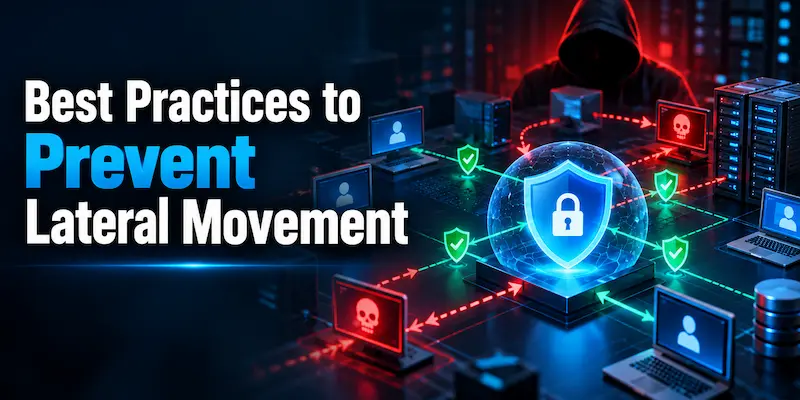
The following are the best practices to prevent lateral movement:
1. Enforce Zero Trust and Network Microsegmentation: To prevent unwanted internal traversal, limit peer-to-peer host connectivity and segregate important network zones.
2. Implement the Principle of Least Privilege (PoLP) and PAM: Restrict user privileges, safeguard administrative accounts, and mandate only-in-time access for critical tasks.
3. Harden Authentication Protocols and Credential Storage: Enable Credential Guard to safeguard memory, phase out insecure protocols like NTLM, and enforce multi-factor authentication everywhere.
4. Disable Unnecessary Native Admin Tools and Protocols: Limit the usage of administration tools such as WMI, PowerShell, and older remote access services on common workstations.
5. Deploy Endpoint Detection and Response (EDR) with Behavior Monitoring: Detect and stop fileless attacks, credential harvesting, and suspicious process execution in real time by continuously analyzing host activity.
Conclusion: Detect and Stop Lateral Movement Early
Now that we have talked about what Lateral Movement is, you might want to get your hands on a dedicated security solution from a reliable source. For that, you can go for ShieldXDR, a dedicated threat detection and response tool offered by Craw Security.
ShieldXDR can help businesses by automatically detecting unknown cyber threats and dealing with them without any human intervention. Thus, you can rely on this amazing tool for security. What are you waiting for? Contact, Now!
Frequently Asked Questions
About Lateral Movement
1. What is lateral movement in cybersecurity?
In cybersecurity, the term "lateral movement" describes the methods adversaries employ to gradually advance through a network, increasing their privileges and breaching more systems in order to access valuable assets.
2. What are the most common signs of lateral movement?
The following are the most common signs of lateral movement:
a) Unusual Remote Logins & Authentication Spikes,
b) Abnormal Use of Administrative Tools,
c) Sudden Privilege Escalation,
d) Anomalous Internal Network Traffic, and
e) Suspicious Credential Access & Memory Abuse.
3. How do attackers perform lateral movement?
Attackers perform lateral movement in the following ways:
a) Credential Theft & Session Hijacking,
b) Abuse of Built-In Management Utilities,
c) Exploitation of Remote Services,
d) Exploiting Unpatched Internal Vulnerabilities, and
e) Internal Reconnaissance & Password Spraying.
4. How can security teams detect lateral movement?
Security teams detect lateral movement in the following ways:
a) Analyze Authentication & Domain Logs,
b) Inspect East-West Traffic Patterns,
c) Audit Command-Line & Process Execution,
d) Monitor Credential Dumping & LSASS Access, and
e) Correlate Telemetry with Behavioral Analytics.
5. Which tools can detect lateral movement?
The following tools can detect lateral movement:
a) Endpoint Detection and Response (EDR) / XDR Platforms,
b) Network Detection and Response (NDR) Tools,
c) User and Entity Behavior Analytics (UEBA),
d) Deception Technology & Honeypots, and
e) Identity Detection and Response (ITDR) & Identity Threat Protection.
6. What network activities indicate lateral movement?
The following network activities indicate lateral movement:
a) Unusual East-West Workstation Traffic,
b) Internal Reconnaissance & Subnet Scanning,
c) Spikes in Remote Management Protocols,
d) Abnormal Active Directory & LDAP Queries, and
e) Unexpected Internal File Transfers.
7. How does credential theft enable lateral movement?
Credential theft enables lateral movement in the following ways:
a) Authenticating as Legitimate Users,
b) Bypassing Authentication Barriers via Hash Reuse,
c) Escalating Privileges Across the Domain,
d) Blending in with Normal Administrative Operations, and
e) Establishing Persistent Multi-Host Access.
8. What is the difference between lateral movement and privilege escalation?
While lateral movement moves horizontally across several systems and network segments to increase access, privilege escalation moves vertically to obtain higher authority (e.g., user to admin) on the same system.
9. How can organizations prevent lateral movement attacks?
Organizations can prevent lateral movement attacks in the following ways:
a) Implement Microsegmentation & Zero Trust,
b) Enforce Least Privilege & PAM,
c) Harden Authentication & Safeguard Credentials,
d) Disable Unnecessary Remote Management Services, and
e) Deploy Endpoint Detection & Response (EDR).
10. Why is early detection of lateral movement important?
Early detection of lateral movement is important for the following reasons:
a) Prevents Access to High-Value Assets,
b) Minimizes Incident Blast Radius,
c) Thwarts Ransomware Deployment & Data Exfiltration,
d) Reduces Attacker Dwell Time, and
e) Preserves Forensic Integrity & Operational Continuity.