
Do you know what Threat Hunting in Cybersecurity is, its uses, its features, and why organizations need it to protect themselves against future threats? If not, then you are in the right place. Here, we will talk about what threat hunting is and related benefits in detail.
Moreover, we will introduce you to a reliable security solution offered by a reputable VAPT service provider. What are we waiting for? Let’s get straight to the topic!
What Is Threat Hunting in Cybersecurity?
Threat hunting is a proactive cybersecurity technique in which security analysts constantly explore networks and enterprise telemetry for hidden enemies that have already gotten past automatic perimeter protections.
Threat hunters use threat intelligence, behavioral analytics, and hypothesis-driven searches mapped to frameworks like MITER ATT&CK to find insider threats, persistent malware, and active threats instead of waiting for system alarms.
Threat hunting helps businesses strengthen their defensive posture and quickly halt sophisticated attack chains by decreasing adversary dwell time and revealing hidden security flaws.
Let’s explore what Threat Hunting in Cybersecurity is, its uses, its features, and related benefits for organizations in the IT Industry!
What Is the Difference Between Threat Hunting and Traditional Threat Detection?
|
S.No. |
Topics |
Factors |
What? |
|
1. |
Threat Hunting (Proactive) |
Initiation Model |
Human-led and hypothesis-driven, hunters actively explore telemetry for concealed adversary behavior, assuming defenders have already been hacked. |
|
Detection Mechanism |
Focuses on subtle living-off-the-land (LotL) tactics that evade automatic alert rules, zero-days, and new, unidentified threats. |
||
|
2. |
Traditional Threat Detection (Reactive) |
Initiation Model |
Trigger-driven: depends on security measures keeping an eye on incoming data and only sending out an alarm when a certain rule or signature is met. |
|
Detection Mechanism |
Targets pre-configured correlation rules designed to identify known attack vectors, known malicious signatures, and IOCs (IPs, hashes). |
Why Is Threat Hunting Important for Modern Cyber Defense?
Threat hunting is important for modern cyber defense for the following reasons:
1. Bypasses Blind Spots of Signature & Rule-Based Controls: Detects living-off-the-land attacks and evasive zero-days that circumvent automated security measures.
2. Drastically Reduces Adversary Dwell Time: Reduces overall impact by evicting unknown intruders in minutes rather than months.
3. Uncovers Unknown Vulnerabilities & Coverage Gaps: Reveals uncontrolled assets, security flaws, and telemetry black spots.
4. Informs Predictive Threat Intelligence & Rules: Transforms innovative attack strategies into automated SOC playbooks and actionable indications.
5. Mitigates High-Impact Insider & Identity Threats: Identifies abnormal internal behaviors and misused legitimate credentials prior to data exfiltration.
What Are the Different Types of Threat Hunting?
The following are the different types of threat hunting:
● Hypothesis-Driven Hunting: Uses MITER ATT&CK methodologies to test particular threat intelligence assumptions against telemetry.
● Baseline / Intelligence-Driven Hunting: Looks for active Indicators of Compromise (IOCs) that correspond with recent threat reports on networks.
● Custom & Behavioral Analytics Hunting: Uses machine learning to analyze unusual system activity and reveal new TTPs.
● Entity & Identity-Focused Hunting: Monitors high-risk user and service accounts to identify instances of privilege escalation and credential abuse.
● Situational Awareness & Crown Jewel Hunting: Concentrates surveillance during high-risk events on valuable assets and vital data repositories.
What Are the Key Steps in the Threat Hunting Process?
|
S.No. |
Steps |
What? |
|
1. |
Hypothesis Formulation |
Describe a specific hypothesis based on critical asset vulnerabilities, MITER ATT&CK methods, or threat intelligence. |
|
2. |
Data Ingestion & Normalization |
Compile and standardize multi-source telemetry from cloud, network, endpoint, and identity contexts into a platform that can be searched. |
|
3. |
Investigation & Execution |
To verify the theory and identify possible attacker tactics, run sophisticated queries and analytics against telemetry. |
|
4. |
Response & Threat Eviction |
To stop the danger, isolate affected systems, remove malicious persistence mechanisms, and invalidate credentials that have been exploited. |
|
5. |
Documentation & Automation |
Document investigation results, close security holes, and create automated detection rules using verified hunting logic. |
What Threat Intelligence and Data Sources Are Required for Threat Hunting?
The following threat intelligence and data sources are required for threat hunting:
a) Endpoint Telemetry & Process Logs: Records file changes, command-line arguments, memory injections, and process creation.
b) Network Traffic & Flow Data: Detects unwanted outgoing connections by ingesting PCAP, NetFlow, DNS data, and proxy logs.
c) Identity, Access & Authentication Records: Monitors SSO events, Active Directory modifications, and MFA logs to identify instances of privilege abuse.
d) Cloud Infrastructure & SaaS Audit Logs: Checks for setup errors in serverless executions, cloud storage access, and API calls.
e) Cyber Threat Intelligence (CTI) & Frameworks: Incorporates MITER ATT&CK maps and threat feeds to direct the development of hypotheses.
What Tools and Technologies Are Used in Threat Hunting?
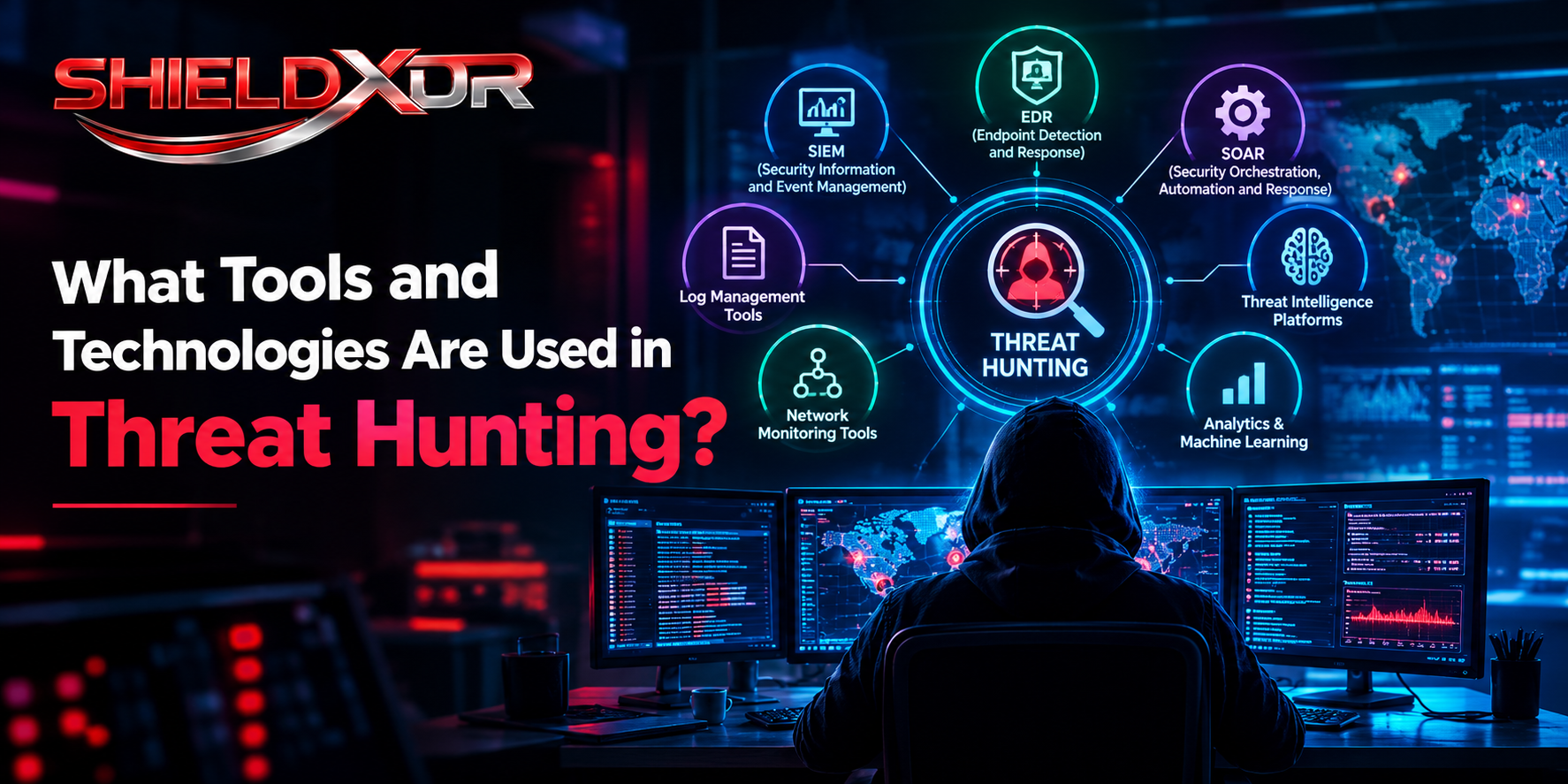
The following tools and technologies are used in threat hunting:
1. Endpoint & Cross-Domain Platforms (EDR/XDR): Gather process execution logs and deep telemetry from many environments and endpoints for interactive hypothesis searches.
2. SIEM & Security Data Lakes: To do long-term behavioral analytics and retrospective threat searches, aggregate and correlate large amounts of previous log data.
3. Network Detection & Response (NDR): Reveals hidden C2 communication channels and lateral movement by analyzing DNS traffic, NetFlow, and raw packets.
4. Threat Intelligence Platforms (TIP) & Open Source Frameworks: Provide MITRE ATT&CK mappings, opponent TTPs, and real-time IOCs to direct the creation of hypotheses.
5. User & Entity Behavior Analytics (UEBA): Uses machine learning and statistical baselining to identify insider threats, unusual logins, and compromised passwords.
What Frameworks (e.g., MITRE ATT&CK) Guide Threat Hunting?
|
S.No. |
Factors |
What? |
|
1. |
MITRE ATT&CK Framework |
Creates hypotheses and validates coverage by mapping actual adversary TTPs. |
|
2. |
Lockheed Martin Cyber Kill Chain |
Determines where to disrupt intruding opponent activity by tracking linear attack phases. |
|
3. |
The Diamond Model of Intrusion Analysis |
Connects victim, adversary, infrastructure, and capability relationships to map intricate campaigns. |
|
4. |
David Bianco’s Pyramid of Pain |
Sets hunting priorities according to TTPs that cause the most disruption to attackers. |
|
5. |
NIST CSF / CTI Frameworks |
Synchronizes hunting processes with organized threat intelligence feeds and enterprise risk management. |
What Challenges Do Security Teams Face in Threat Hunting?
Security teams face the following challenges in threat hunting:
● Overwhelming Telemetry Volume & Signal Noise: Subtle adversary signals are obscured by alert fatigue caused by high log volume and false positives.
● Severe Talent Shortage & Specialized Skill Requirements: It is quite challenging to find analysts with expertise in behavioral analytics, threat intelligence, and reverse engineering.
● Fragmented Data Visibility & Security Silos: Cross-domain adversary movements are concealed by blind spots created by disconnected security tools.
● Time-Intensive Manual Investigation & Scale Constraints: Analyst coverage across enterprise assets is substantially hampered by unstructured hunting inquiries, which take hours to complete.
● Advanced Adversary Evasion Techniques: To blend in with genuine traffic, sophisticated threat actors employ encrypted C2, living-off-the-land binaries, and anti-forensics.
What Is the Future of Threat Hunting in Cybersecurity?
Agentic AI and multi-agent hyperautomation, where autonomous security agents continually generate hypotheses, carry out cross-domain inquiries, and initiate containment operations in real time, are key components of the future of threat hunting.
As a result, security personnel take on a "human-on-the-loop" governance role, enabling hunters to oversee self-learning AI systems that eliminate analyst alert fatigue and defeat sophisticated, machine-speed threats.
Conclusion: How Can Threat Hunting Improve Your Cyber Defense Strategy?
Now that we have talked about what threat hunting in cybersecurity is, you might want to get your hands on a dedicated security solution from a reliable source. For that, you can go for ShieldXDR, a dedicated threat detection and response tool offered by Craw Security.
ShieldXDR can help businesses to improve their business’s security by automatically detecting cyber threats and vulnerabilities while dealing with it without any human intervention. What are you waiting for? Contact, Now!
Frequently Asked Questions
About Threat Hunting in Cybersecurity
1. What Is Threat Hunting in Cybersecurity?
In order to find, locate, and eliminate hidden attackers that have gotten past automated systems, security analysts constantly query and examine company telemetry as part of the proactive cybersecurity technique known as "threat hunting."
2. How Does Threat Hunting Strengthen Cyber Defense?
Threat hunting strengthens cyber defense in the following ways:
a) Eliminates Defender Blind Spots,
b) Compresses Adversary Dwell Time,
c) Reduces Attack Surface & Exposure,
d) Enhances Automated SOC Rules, and
e) Neutralizes Identity & Insider Threats.
3. What Are the Main Types of Threat Hunting?
The following are the main types of threat hunting:
a) Hypothesis-Driven Hunting,
b) Intelligence-Driven Hunting,
c) Behavioral & Analytics Hunting,
d) Identity & Entity-Focused Hunting, and
e) Crown Jewel & High-Value Asset Hunting.
4. How Does Threat Hunting Differ From Traditional Threat Detection?
While threat hunting proactively and hypothesis-drivenly analyzes business telemetry to find new adversaries that have previously evaded controls, traditional threat detection relies reactively on automated rules and signatures to trigger alerts on recognized threats.
5. What Are the Key Steps in the Threat Hunting Process?
The following are the key steps in the threat hunting process:
a) Hypothesis Formulation,
b) Data Ingestion & Normalization,
c) Investigation & Query Execution,
d) Response & Threat Eviction, and
e) Documentation & Automation Feedback.
6. What Tools Are Used for Threat Hunting?
The following tools are used for threat hunting:
a) Endpoint & Cross-Domain Detection (EDR / XDR),
b) SIEM & Security Data Lakes,
c) Network Detection & Response (NDR),
d) Threat Intelligence Platforms (TIP) & Feeds, and
e) User & Entity Behavior Analytics (UEBA).
7. What Are the Benefits of Proactive Threat Hunting?
The following are the benefits of proactive threat hunting:
a) Dramatically Compressed Dwell Time,
b) Neutralization of Evasive Threats,
c) Proactive Security Posture Hardening,
d) Optimization of SOC Operations, and
e) Protection of High-Value & Identity Assets.
8. What Challenges Do Organizations Face in Threat Hunting?
Organizations face the following challenges in threat hunting:
a) Data Overload & Noise Friction,
b) Specialized Talent Shortages,
c) Siloed Data & Blind Spots,
d) Evasive & Machine-Speed TTPs, and
e) High Operational & Resource Costs.
9. How Often Should Organizations Conduct Threat Hunting?
In addition to planned weekly or monthly deep-dive hypothesis hunts and prompt trigger-based investigations following significant intelligence leaks, organizations should regularly engage in threat hunting utilizing automated AI telemetry analytics.
10. How Can Businesses Build an Effective Threat Hunting Program?
Businesses can build an effective threat hunting program in the following ways:
a) Establish Full-Spectrum Telemetry & Data Centralization,
b) Leverage Frameworks & Threat Intelligence,
c) Combine Specialized Talent with AI Automation,
d) Adopt an Iterative Hunting Lifecycle, and
e) Operationalize Hunt Findings into Controls.