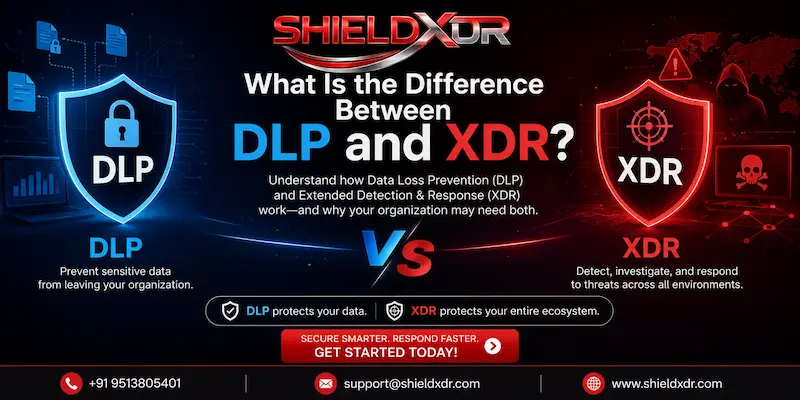
Do you know about the difference between DLP and XDR, and how they can help organizations against online threats? If not, then you are at the right place. Here, we will talk about their differences, similarities, and benefits in detail.
Moreover, we will introduce you to a reliable XDR solution offered by a reputable VAPT service provider. What are we waiting for? Let’s get started!
What is Data Loss Prevention (DLP)?
Data Loss Prevention (DLP) is an all-encompassing cybersecurity approach that identifies, monitors, and safeguards critical data throughout an organization's network using software tools and stringent standards.
DLP systems instantly identify unwanted attempts to copy or transfer private files, including intellectual property or citizen data, by scanning data while it is in motion, at rest, and in use. The solution efficiently prevents catastrophic data breaches and ensures compliance with regulatory obligations by immediately blocking the transfer and alerting security professionals when a policy violation occurs.
Let’s talk about what DLP and XDR are and how they can help organizations running in the IT Industry!
What is Extended Detection and Response (XDR)?
An innovative cybersecurity technique called Extended Detection and Response (XDR) combines threat information from several security layers, such as servers, networks, endpoints, cloud workloads, and emails, into a single, cohesive platform.
Through the use of automated analytics and artificial intelligence to correlate this disparate data, XDR gives security professionals a central interface from which to detect, hunt, and quickly neutralize sophisticated threats throughout the entire company ecosystem.
Key Features of DLP Solutions
The following are some of the key features of DLP solutions:
1. Automated Data Discovery and Classification: Sensitive data is automatically scanned and labeled using pre-established business and regulatory rules.
2. Multi-State Data Monitoring: Keeps track of and protects data as it's being used, stored, or transferred across networks.
3. Policy-Driven Enforcement and Prevention: Encrypts crucial files in accordance with company security guidelines and instantly prevents unwanted data transfers.
4. Centralized Incident Management and Reporting: Enables quick triage and compliance audits by combining all data warnings into a single dashboard.
5. Content- and Context-Aware Analysis: Examines the surrounding context (such as user role and destination) in addition to the file text in order to prevent leaks.
Key Features of XDR Platforms
The following are the key features of XDR platforms:
● Cross-Domain Telemetry Ingestion: Gathers and aggregates security information from email streams, networks, cloud environments, and endpoints.
● AI-Powered Alert Correlation: Combines several suspicious occurrences into a coherent, high-fidelity assault tale using machine learning.
● Automated Playbook Orchestration: Instantly initiates response workflows that have been preconfigured to isolate affected hosts and stop threats without the need for human intervention.
● Unified Security Console: Eliminates screen fatigue by combining the investigation, hunting, and reaction operations into a single dashboard.
● Proactive Threat Hunting and Intel: Incorporates sophisticated query tools and real-time threat feeds to identify intruders lurking within the network.
DLP vs XDR: Key Differences at a Glance
|
S.No. |
Topics |
Factors |
What? |
|
1. |
DLP |
Core Focus |
Focuses solely on data security, preventing sensitive information from being accessed, leaked, or exfiltrated. |
|
Primary Mechanism |
Uses policy-matching procedures, data classification, and content inspection to prevent illegal data transfers. |
||
|
Main Objective |
Help prevent employee data leaks, prevent inside-out threats, and guarantee adherence to privacy laws like GDPR and HIPAA. |
||
|
2. |
XDR |
Core Focus |
Focuses on incident response and threat detection throughout the whole enterprise architecture (endpoints, network, cloud, and email). |
|
Primary Mechanism |
Uses automated playbooks, behavioral analysis, and telemetry correlation driven by AI to find active attackers. |
||
|
Main Objective |
To prevent advanced persistent attacks (APTs), ransomware execution, harmful malware, and outside-in threats from causing harm. |
Benefits of Implementing DLP
The following are the benefits of implementing DLP:
a) Prevents Intentional and Accidental Data Leaks: Prevents employees from unintentionally disclosing private information and prevents harmful insider exfiltration.
b) Ensures Regulatory Compliance: Automatically complies with stringent data security regulations, such as GDPR, HIPAA, and PCI-DSS, to prevent costly fines.
c) Provides Complete Data Visibility: Sensitive information is mapped and tracked throughout your network, cloud storage, and endpoints.
d) Protects Intellectual Property and Brand Reputation: Protects customer confidence, trade secrets, and proprietary source code from damaging public exposure.
e) Optimizes Incident Response Prioritization: Enables security teams to respond more quickly by filtering out background noise to identify high-risk data infractions.
Benefits of Implementing XDR
The following are the benefits of implementing XDR:
1. Unified Visibility Across Silos: Combines telemetry from endpoints, networks, and clouds into a single stream to close the visibility gap.
2. Accelerated Time to Detect and Respond (MTTD/ MTTR): Accelerates containment by automatically assembling hints to identify and thwart covert attacks early on.
3. Reduced Alert Fatigue: Saves analysts from alert burnout by combining thousands of low-level signals into a small number of high-fidelity situations.
4. Automated Threat Containment: Carries out immediate, pre-programmed defense measures, such as isolating compromised hosts, as soon as a danger is detected.
5. Lower Total Cost of Ownership (TCO): Reduces total costs by substituting a single integrated security platform for several separate point tools.
DLP vs XDR: Which Solution Does Your Business Need?
|
S.No. |
Topics |
Factors |
What? |
|
1. |
DLP |
Stop Data Leaks and Insider Risks |
Employees must be prevented from transferring source code, financial information, or client data outside of the company network, whether on purpose or by accident. |
|
Pass Regulatory Compliance Audits |
To avoid expensive legal fines, your industry needs strict adherence to data protection laws such as HIPAA, GDPR, or PCI DSS. |
||
|
Map and Classify Dark Data |
Sensitive data saved on your internal servers, cloud storage, and endpoints is not visible to you. |
||
|
2. |
XDR |
Defend Against Complex Cyberattacks |
Preventing ransomware, zero-day malware, and foreign hackers from compromising your infrastructure should be your top focus. |
|
Unify a Fractured Security Stack |
Disconnected alarms from various endpoints, email, cloud, and network security tools are overwhelming your IT staff. |
||
|
Automate Threat Response |
You require automated playbooks to quickly isolate compromised devices because you don't have a large, round-the-clock Security Operations Center (SOC). |
Why Should Businesses Consider Using Both DLP and XDR?
Businesses should consider using both DLP and XDR for the following reasons:
● Eliminates Blind Spots (Full-Spectrum Defense): While DLP makes sure private information doesn't leak out, XDR prevents external hackers from breaking in.
● Accelerates Insider Threat Detection: As soon as DLP detects a user attempting to copy confidential files, XDR flags questionable user activities (such as strange login times).
● Supercharges Ransomware Mitigation: DLP prevents criminals from stealing and disclosing your data before XDR destroys the ransomware encryption process.
● Enriches Incident Response Context: Security teams can see exactly how an attacker gained access and what data they attempted to steal by combining the two tools.
● Achieves Holistic Security Compliance: Together, they concurrently meet stringent data privacy laws and operational threat-detection requirements.
How Do DLP and XDR Work Together in a Modern Cybersecurity Strategy?
DLP and XDR work together in a modern cybersecurity strategy in the following ways:
a) Correlating Behavioral Anomalies with Data Movement: Connects unusual user behavior (such as logging in at three in the morning) to large file downloads to quickly identify insiders.
b) Defeating "Double Extortion" Ransomware: While DLP prevents threat actors from stealing data to extort the business, XDR eliminates the malware payload.
c) Streamlining Incident Response Context: Gives analysts a single story that details the specifics of a hacker's entry and the files they attempted to access.
d) Automating Cross-Domain Containment Playbooks: Detects a sensitive data leak, instantly disables the user's account, and isolates their laptop.
e) Creating a Zero-Trust Verification Loop: Restricts data access as soon as a device becomes compromised and uses threat data to continuously reevaluate user confidence levels.
How does PhishNext Strengthens Your Cybersecurity with DLP and XDR?
|
S.No. |
Factors |
How? |
|
1. |
Eliminates Blind Spots via Full-Spectrum Defense |
Prevents outside threats from breaching your perimeter and guarantees that private information cannot be disclosed. |
|
2. |
Accelerates Insider Threat Detection |
Immediately neutralizes rogue personnel by linking irregular user behavior to illicit data access. |
|
3. |
Neutralizes Double-Extortion Ransomware |
Eliminates harmful encryption programs while firmly preventing criminals from stealing files for their own use. |
|
4. |
Enriches Incident Response with Deep Context |
Provides analysts with a cohesive timeline that demonstrates the precise entry method and data that an attacker targeted. |
|
5. |
Creates a Dynamic Zero-Trust Security Loop |
The moment an endpoint or user account shows suspicious activity, data access privileges are immediately revoked. |
Conclusion
Now that we have talked about what DLP and XDR are, you might want to get your hands on a dedicated threat detection & response solution from a reliable source. For that, you can go for ShieldXDR, a dedicated threat detection and response tool offered by Craw Security.
ShieldXDR can automatically detect suspicious activities & can respond to them with ease so that the users can feel safer in their working environment. What are you waiting for? Contact, Now!
Frequently Asked Questions
About DLP and XDR
1. What is the main difference between DLP and XDR?
The primary distinction is that XDR concentrates on identifying and eliminating active cyberattacks throughout your whole company network, whereas DLP is solely concerned with preventing sensitive information from leaking out.
2. Can DLP and XDR be used together?
Yes, DLP and XDR can work together to create a comprehensive defense in which DLP stops illegal data from being stolen or disclosed while XDR finds and eliminates active cyberthreats.
3. Which is better for preventing data breaches, DLP or XDR?
Because they focus on distinct aspects of a breach, neither is always superior: XDR is better at preventing malware and external hackers from accessing your systems, while DLP is better at avoiding insider data breaches or unintentional disclosure.
4. Does XDR replace traditional antivirus software?
Yes, XDR replaces conventional antivirus software by going beyond simple malware detection to offer thorough, AI-driven threat detection and automated response throughout your whole digital environment.
5. Is DLP only used for insider threats?
No, DLP stops external hackers who attempt to exfiltrate stolen files after breaking into your network. It is not just for internal threats.
6. Which industries benefit the most from DLP and XDR?
The following industries benefit most from DLP and XDR:
a) Healthcare,
b) Banking and Financial Services,
c) Government and Public Sector,
d) Retail and E-Commerce, and
e) Technology and Intellectual Property (R&D).
7. How does XDR improve incident detection and response?
XDR can improve incident detection and response in the following ways:
a) Eliminates Security Silos,
b) Automates Alert Correlation,
c) Accelerates Triage with Behavioral Analytics,
d) Executes Automated Response Playbooks, and
e) Streamlines Threat Hunting and Root-Cause Analysis.
8. What are the biggest challenges of implementing DLP?
The following are the biggest challenges of implementing DLP:
a) Accurate Data Classification,
b) High Rates of False Positives,
c) Complex Data Sprawl,
d) Employee Resistance and Cultural Friction, and
e) Continuous Maintenance and Policy Tuning.
9. Is XDR suitable for small and medium-sized businesses?
Because its integrated automation and centralized console serve as a force multiplier for lean IT teams without a sizable, dedicated security operations center, XDR is indeed ideal for small and medium-sized enterprises.
10. How can PhishNext help organizations implement DLP and XDR solutions?
PhishNext can help organizations implement DLP and XDR solutions in the following ways:
a) Hardening the "Human Firewall" Against Intrusions,
b) Cultivating Data-Handling Compliance Culture,
c) Providing Extension-Level Browser Protection,
d) Securing Emerging Shadow IT and AI Sprawl, and
e) Aligning Human Metrics with Technical Compliance.