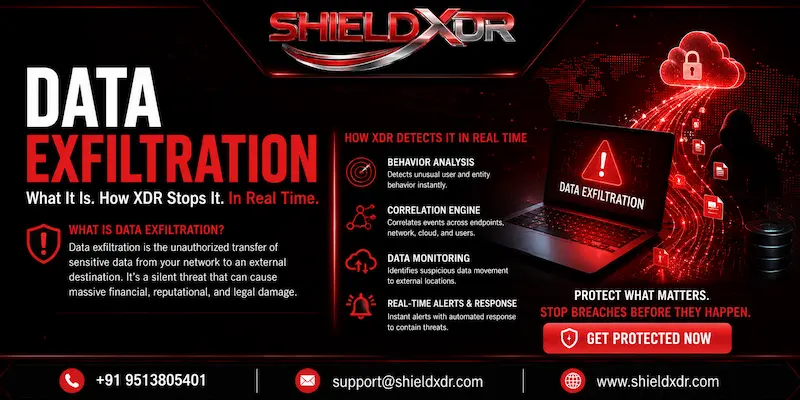
Do you know what Data Exfiltration is and how you can secure yourself against such attempts? If not, then you are at the right place. Here, we will talk about data exfiltration and prevention techniques in detail.
Moreover, we will introduce you to a reliable XDR solution offered by a reputable VAPT service provider. What are we waiting for? Let’s get started!
What Is Data Exfiltration?
The illegal movement or theft of private data from a secure network to an outside location under the control of a malevolent actor is known as data exfiltration. Cyberattacks, malware infections, or insider threats that use popular channels like email, cloud storage, and encrypted web traffic to get over security barriers can cause this.
After being retrieved, this stolen consumer or company data is usually used for corporate espionage, retained for ransomware extortion, or sold on the dark web. Let’s take a look at what Data Exfiltration is, its uses, impacts, and prevention!
Common Methods Attackers Use to Exfiltrate Data
|
S.No. |
Factors |
What? |
|
1. |
Cloud Storage and Web Services |
Exfiltrating data by uploading files straight to file-sharing websites or trustworthy personal cloud drives to blend in with regular online activity. |
|
2. |
DNS Tunneling |
Concealing stolen data segments inside innocuous-looking domain name requests to evade detection by normal company firewalls. |
|
3. |
Encrypted Communication Channels (HTTPS/ VPNs) |
To prevent security filters from reading the contents of the outgoing transmission, stolen material is hidden behind encrypted web traffic. |
|
4. |
Email and Messaging Apps |
Sending private documents across the network via encrypted chat programs or as straightforward email attachments. |
|
5. |
Physical Media (USB and Local Hardware) |
Transferring files to mobile devices, external hard drives, or pocket-sized USB drives to walk data out the door. |
Why Traditional Security Tools Fall Short?
Traditional security tools fall short for the following reasons:
1. They Focus on Entry, Not Exit: Once an attacker has gained access, outbound data transfers are mainly ignored by legacy defenses, which emphasize preventing exterior intrusions.
2. They Rely on Static Signatures: Conventional technologies are ineffective against new, custom exfiltration scripts or fileless attacks and only detect known, identical threat types.
3. They Cannot Read Encrypted Blind Spots: Attackers can transport data out fully undetected because standard firewalls are unable to inspect within outgoing HTTPS or VPN traffic.
4. They Flood Teams with Contextless Alerts: Massive amounts of isolated alarms are produced by legacy monitoring, which leads to warning fatigue and conceals real, slow-drip data theft.
5. They Misjudge Legitimate User Behavior: The behavioral context necessary to distinguish between an employee performing their duties and an insider gathering data is absent from older security stacks.
What Is XDR?
A cybersecurity solution called Extended Detection and Response (XDR) automatically combines and examines threat data from several security levels, such as endpoints, networks, cloud servers, and emails.
XDR gives security professionals comprehensive visibility to identify, pursue, and stop sophisticated attacks more quickly than with conventional isolated technologies by combining these disparate data streams into a unified timeline.
How Does XDR Work?
|
S.No. |
Factors |
How? |
|
1. |
Centralized Data Aggregation |
XDR continuously gathers security data into a single repository from cloud environments, email gateways, network firewalls, and endpoints. |
|
2. |
Intelligent Data Normalization and Stitching |
The system connects isolated events across several domains and converts various log formats into a common language. |
|
3. |
AI-Driven Threat Correlation |
In order to identify subtle, multi-stage attack patterns that human analysts would overlook, sophisticated machine learning algorithms examine the stitched data. |
|
4. |
Unified Incident Prioritization |
XDR creates a single, high-fidelity event timeline prioritized by severity by removing background noise and merging relevant alarms. |
|
5. |
Automated, Cross-Domain Response |
The platform initiates coordinated containment operations, such as blocking a malicious IP at the firewall and isolating an infected laptop at the same time. |
Key XDR Capabilities That Power Real-Time Detection
The following are some key XDR capabilities that power real-time detection:
● Continuous Cross-Layer Data Ingestion: Concurrently gathers and transmits real-time information from cloud workloads, email servers, network traffic, and endpoints into a single analytical engine.
● Automated Identity and Behavioral Correlation: Tracks an attacker's lateral movement across many organizational domains by instantly connecting user credentials with machine activity.
● Behavioral Heuristics and Anomaly Detection: Detects zero-day threats that lack known malware signatures by flagging abnormal, fileless departures from baseline network behavior.
● Dynamic Attack Timeline Reconstruction: Automatically assembles disparate alarm fragments into a visual, chronological picture of the complete intrusion trail.
● Proactive Native Threat Hunting: Gives security teams access to centralized, cross-domain query capabilities so they may simultaneously look for hidden signs of penetration throughout the whole infrastructure.
How XDR Detects Data Exfiltration in Real Time?
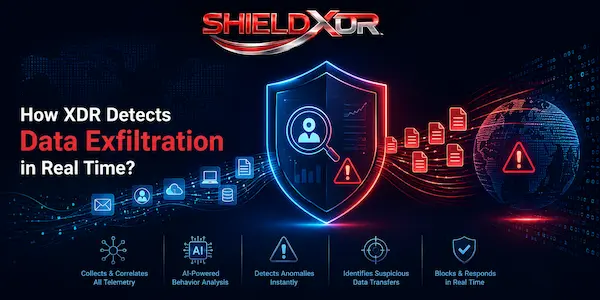
In the following ways, XDR detects data exfiltration in real time:
a) Correlates Endpoint Harvesting with Network Anomalies: Stops a device just before it starts an abrupt, enormous outbound data transfer by copying large local files.
b) Inspects Encrypted Traffic for Tunneling Signatures: Finds hidden data streams concealed inside valid HTTPS or DNS queries by analyzing packet behavior and metadata.
c) Tracks Lateral Movement and Identity Abuse: Identifies a hacked user account that is moving between servers to access data directories it has never accessed previously.
d) Flags Unusual Cloud and SaaS API Activity: Identifies automated programs or bulk download requests that extract enormous volumes of data from cloud repositories such as AWS or SharePoint.
e) Monitors Unsanctioned Data Transfers to Personal Channels: Prevents or alerts users who try to transfer company files to unapproved personal email accounts or public file-sharing websites.
XDR vs. SIEM vs. EDR: Who Wins at Detecting Exfiltration?
|
S.No. |
Topics |
Factors |
What? |
|
1. |
EDR |
The Granular Internal Spy |
Detects whether a local user or malware executes a script to compress files, retrieve data from a database, or copy data to a USB drive, and is excellent at stopping data harvesting at its source. |
|
The Blind Spot |
Completely overlooks data theft in the event that an attacker circumvents the physical endpoint by using compromised cloud credentials or API access. |
||
|
2. |
SIEM |
The High-Level Archive |
Gathers compliance logs from all of the business network's databases, firewalls, and older servers to provide the ultimate paper trail. |
|
The Blind Spot |
Due to its reliance on static rules and delayed log ingestion, it struggles with slow-drip exfiltration and frequently notifies analysts hours after the data has left the building. |
||
|
3. |
XDR |
The Cross-Domain Coordinator |
Wins at exfiltration by providing analysts with a single, real-time image of the complete theft pipeline by quickly combining endpoint data, network traffic, and cloud API logs. |
|
The Response Advantage |
Can initiate automated, cross-layer containment measures, such as blocking a malicious outgoing IP and locking a compromised identity at the same time before the exfiltration is finished. |
Real-World Use Cases: XDR Catching Data Exfiltration in Action
The following are some real-world use cases:
1. Neutralizing the "Slow-Drip" Insider Threat: A retiring employee who downloads small amounts of source code over several weeks is flagged by XDR, and their access is blocked before their last day.
2. Intercepting Ransomware Staging and Extortion: Before the attacker can upload the stolen data to an extortion site, XDR detects malware compressing local databases and cuts off the network connection.
3. Cracking Stealthy DNS Tunneling Exfiltration: When XDR detects that a server is continuously sending strange lookups to an external domain, it immediately isolates the system to stop the covert data leak.
Best Practices for Maximizing XDR's Detection Effectiveness
The following are some of the best practices for maximizing XDR’s detection effectiveness:
● Enforce Comprehensive Log Sources: To remove defensive blind spots, provide XDR high-fidelity telemetry from all endpoints, networks, cloud environments, and identity providers.
● Integrate Continuous Cyber Risk Quantification (CRQ): Prioritize the hazards that pose the biggest financial danger to the company by mapping XDR alert patterns directly against your CRQ financial models.
● Customize and Test Automated Playbooks: Customize your containment response scripts to fit your unique asset structure, then use frequent simulation exercises to verify them.
● Keep Threat Intelligence Feeds Updated: Incorporate real-time, high-quality global indicators of compromise to identify emerging advanced persistent threats and new zero-day assaults.
● Establish a Continuous Tuning and Feedback Loop: To reduce background noise and avoid security analyst fatigue, assess and modify alert thresholds on a regular basis.
Conclusion: Why XDR Is Essential for Modern Data Protection
Now that we have talked about what Data Exfiltration is, you might want to get a dedicated XDR solution from a reliable source. For that, you can go for ShieldXDR, a dedicated threat detection and response tool offered by Craw Security.
ShieldXDR can help you to automatically detect unknown and suspicious activity on your system and respond to it accordingly to be on the safer side. Thus, you can feel protected even when you’re not on the system to monitor. What are you waiting for? Contact, Now!
Frequently Asked Questions
About Data Exfiltration
1. What is data exfiltration in simple terms?
Simply put, data exfiltration occurs when an insider or cybercriminal steals confidential firm information from a secure corporate network without authorization.
2. How is data exfiltration different from a data breach?
Data exfiltration is the particular act of those individuals taking and removing the data from the network, whereas a data breach is any security occurrence in which unauthorized individuals obtain access to sensitive data.
3. What are the most common signs of data exfiltration?
The following are the most common signs of data exfiltration:
a) Unusual Outbound Traffic Spikes,
b) Abnormal Cloud or SaaS Downloads,
c) Frequent Large File Compression,
d) Unsanctioned External Connections, and
e) Spikes in DNS Queries (Tunneling).
4. Can data exfiltration happen without malware?
Yes, when attackers utilize compromised legitimate credentials, misuse built-in system administrative capabilities (sometimes referred to as "living off the land"), or when malevolent insiders just copy files to unapproved cloud storage or USB drives, data exfiltration can occur entirely without malware.
5. How does XDR differ from traditional antivirus software?
XDR keeps an eye on your entire network, cloud, and email environment to identify intricate, multi-step attacks, whereas standard antivirus software just looks for known harmful files on a single device.
6. How long does it typically take XDR to detect data exfiltration?
Since XDR continuously correlates live network traffic, cloud behavior, and endpoint activity as soon as the suspicious transfer starts, it usually finds data exfiltration in real time or within minutes.
7. Can XDR detect insider threats attempting to exfiltrate data?
Yes, by creating a behavioral baseline for every user and sending out alerts if an employee deviates from their regular routine, for example, by downloading large files or accessing sensitive directories they have never accessed before XDR is able to identify insider threats in real time.
8. Does XDR work effectively in cloud and hybrid environments?
Because it naturally interfaces with cloud APIs, containers, and virtual infrastructure to track data transfer and identity permissions across both on-premises servers and public clouds, XDR does indeed function extremely well in cloud and hybrid contexts.
9. What industries are most vulnerable to data exfiltration attacks?
The following industries are most vulnerable to data exfiltration attacks:
a) Healthcare,
b) Manufacturing,
c) Financial Services & Insurance,
d) Education & Higher Research, and
e) Government & Public Administration.
10. Is XDR enough on its own to prevent data exfiltration completely?
No, XDR is not a panacea; in order to create a genuinely impenetrable barrier against data exfiltration, it must be combined with stringent Data Loss Prevention (DLP) policies, strong Identity and Access Management (IAM), and ongoing employee training.