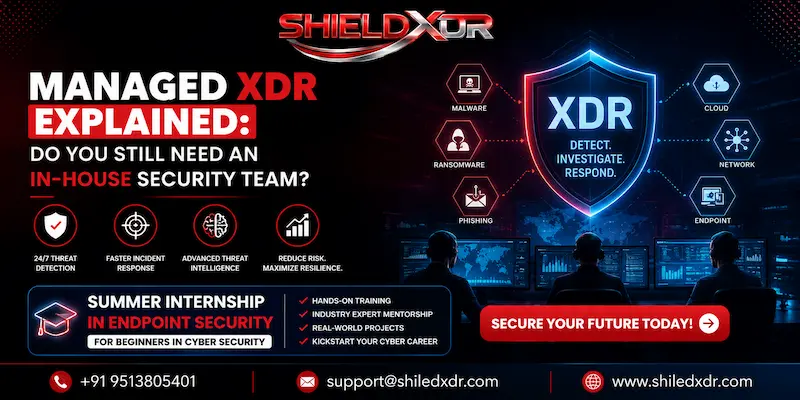
Do you know how Managed XDR is beneficial for organizations in the IT Industry and how you can get the best XDR solution at your fingertips? If not, then you are at the right place. Here, we will talk about what Managed XDR is and related features.
Moreover, we will introduce you to a reliable XDR solution offered by a reputable VAPT service provider. What are we waiting for? Let’s get straight to the topic!
What Is Managed XDR?
An organization's whole digital ecosystem, including endpoints, networks, cloud environments, and identity systems, is continuously monitored by Managed Extended Detection and Response (Managed XDR), a human-led, outsourced cybersecurity solution that aggressively searches for hidden dangers.
It combines sophisticated cross-layered visibility with a dedicated, round-the-clock Security Operations Center (SOC) team that actively triages, isolates, and fixes security breaches on your behalf, in contrast to traditional automated software.
It minimizes security alert fatigue and quickly stops sophisticated assaults before they cause operational damage by combining several data sources and weaponizing human expertise. Let’s take a look at what Managed XDR is, its uses, its features, and how it can benefit your organization!
Managed XDR vs Traditional Security Monitoring
|
S.No. |
Topics |
Factors |
What? |
|
1. |
Managed XDR |
Unified Data Correlation |
Automatically creates a single, thorough attack chronology by combining security telemetry from endpoints, networks, cloud environments, and identities. |
|
24/ 7 Human-Led Expertise |
Supported by a round-the-clock, outsourced Security Operations Center (SOC) that only verifies high-priority threats and eliminates false positives. |
||
|
Proactive Guided Response |
Goes beyond basic detection by immediately carrying out automated containment procedures (such as banning a compromised account or isolating an infected laptop) as soon as a danger is verified. |
||
|
2. |
Traditional Security Monitoring |
Fragmented Visibility |
Depends on discrete silos (such as separate firewall logs and antivirus software) that don't connect the dots, creating blind spots that skilled attackers can take advantage of. |
|
Passive Alerting |
Serves mostly as an alarm system, producing enormous amounts of raw notifications that your internal team must manually sort, evaluate, and look into. |
||
|
Reactive Resolution |
Provides little to no automatic mitigation; if an alert is set out, the reaction is completely manual and depends on the availability and quickness of internal IT personnel to stop the breach. |
Key Components of a Managed XDR Service
The following are some key components of a managed XDR Service:
1. Cross-Layer Telemetry Ingestion: Eliminates security blind areas by continuously gathering data from your endpoints, network, cloud environments, and identity systems.
2. Automated Data Correlation and Analytics: Uses machine learning engines to quickly connect disparate events into a cohesive, intelligible assault timeline.
3. 24/7 Elite SOC Team (Human Expertise): Supported by a round-the-clock Security Operations Center manned by analysts who verify actual threats and weed out bogus alarms.
4. Proactive Threat Hunting: Finds hidden attackers who have gotten past common automated defenses by searching your network environment.
5. Orchestrated Incident Response and Remediation: Carries out quick, decisive containment procedures, such as deactivating compromised credentials or isolating affected machines, to immediately halt a live breach.
How Managed XDR Works?
Managed XDR works in the following ways:
● Continuous Data Collection: Sensors continuously retrieve real-time security records from user IDs, cloud platforms, network traffic, and your endpoints.
● Centralized Analysis and Correlation: The actual path of an assault is revealed by a central engine that automatically matches distinct events across those several layers.
● Human Validation and Triage: To eliminate false alarms and verify actual malicious activity, skilled security analysts examine the connected warnings.
● Immediate Automated Containment: Instant defense procedures, such as locking hacked user accounts or removing compromised devices from your network, are triggered by the service.
● Remediation and Root-Cause Review: To stop such instances in the future, engineers fully remove any leftover malware, patch the original entry point, and record the breach.
The Role of an In-House Security Team
|
S.No. |
Roles |
What? |
|
1. |
Defining Security Policy and Governance |
Defines the fundamental policies, security frameworks, and compliance standards that govern how the business safeguards its data assets. |
|
2. |
Managing Internal Risk and Architecture |
Regularly evaluates internal operational vulnerabilities while designing and maintaining the company's secure network architecture. |
|
3. |
Driving Security Awareness Training |
Teaches staff members how to recognize phishing scams, create secure passwords, and adhere to everyday cybersecurity best practices. |
|
4. |
Directing Incident Response Collaboration |
Serves as the internal commander in the event of a breach, working closely with outside Managed XDR providers to oversee recovery and containment. |
|
5. |
Aligning Security with Business Goals |
Converts technical cybersecurity threats into financial effects to gain executive support and strike a balance between security and business expansion. |
Can Managed XDR Replace an Internal Security Team?
No, Managed XDR cannot take the position of an internal security team because, although it is excellent at detecting technological threats and containing incidents around the clock, it lacks the organizational context required to manage business risk, establish security policies, and provide staff training.
Rather, it acts as a potent force multiplier, relieving your internal team of tactical monitoring so they can concentrate on long-term security architecture and strategic governance.
Benefits of Combining Managed XDR with Internal Security Staff
The following are the benefits of combining managed XDR with internal security staff:
a) 24/7 Monitoring Without Burnout: Offloads overnight alert tracking to prevent burnout and lets your staff sleep.
b) Rapid, Context-Aware Incident Response: Combines the speed of MXDR with the inside expertise of your team to provide extremely accurate confinement.
c) Strategic Shift from Tactical to Proactive: Allows your employees to concentrate on core security architecture instead of sorting alerts.
d) Access to Specialized Global Threat Intelligence: Give your team access to up-to-date information on ongoing international hacking initiatives.
e) Drastically Reduced Time to Containment (MTTR): Prevents live threats from spreading throughout your network in a matter of minutes.
Cost Comparison: Managed XDR vs Building an Internal SOC
In order to build an internal 24/7 SOC in India, a significant yearly capital investment of ₹3 to ₹7 crore is needed to pay for real estate, software licenses (SIEM/SOAR), and at least 10 to 12 multi-shift analysts.
Managed XDR, on the other hand, combines these costs into a predictable subscription model that starts at ₹30 to ₹80 lakh annually and offers comparable or better global threat protection at a 5x to 10x cost reduction.
Challenges and Limitations of Managed XDR
The following are some challenges and limitations of managed XDR:
1. Integration Complexity and Data Gaps: Data collection may be impeded by outdated systems or mismatched software, resulting in risky security blind spots.
2. Over-Reliance on the Provider's Tech Stack: Switching providers later on is quite costly and complicated when you are locked into one vendor's ecosystem.
3. The "Shared Responsibility" Communication Gap: If it's unclear who authorizes actions during a live breach, critical response time may be lost.
4. Lack of Deep Internal Context: External providers find it difficult to differentiate between legitimate attacks and typical, tailored corporate network activities.
5. Variable Levels of True Automation: When it comes to limiting dangers, many services still primarily rely on manual human involvement, which might result in unanticipated delays.
How to Transition to a Hybrid Security Model?
You can transition to a hybrid security model in the following ways:
● Audit and Map Your Security Telemetry: To determine precisely what logs the hybrid partner needs to consume, document your current tools and data sources.
● Establish Clear Ownership and RACI Matrices: Make a clear grid outlining who is accountable, informed, consulted, and responsible for each security event.
● Define Actionable Rules of Engagement: Set pre-approved boundaries that specify when the provider can isolate devices on their own and when they need to wait for approval from your team.
● Integrate Tools and Communication Pipelines: For easy, real-time alert collaboration, connect your partner's monitoring dashboard straight into your internal messaging systems.
● Conduct Simulated Fire Drills (Tabletop Exercises): To verify your team's communication and address any gaps in your response plan, conduct frequent, realistic breach simulations.
How to Choose the Right Managed XDR Provider?
|
S.No. |
Factors |
How? |
|
1. |
Technology Compatibility (Open vs. Native XDR) |
Make sure the supplier complements your selected single-vendor suite (Native) or seamlessly integrates with your current security technologies (Open). |
|
2. |
True Threat Containment SLA |
Instead of just basic alarm notification times, look for specific Service Level Agreements that ensure active breach containment within minutes. |
|
3. |
Geographic and Compliance Alignment |
Choose a service that complies with your particular data residency rules and has regional SOC analysts who are knowledgeable about local danger environments. |
|
4. |
Transparent Data-Volume Pricing |
Selecting predictable, flat-rate pricing based on users or endpoints instead of erratic data volume ingestion will help you avoid hidden operating costs. |
|
5. |
Advanced Automation and Threat Hunting Proactiveness |
Make sure the provider employs both expert human teams that aggressively search for hidden attackers and machine learning for immediate triage. |
Service Level Agreements (SLAs) and Metrics to Watch
Mean Time to Detect (MTTD), which ensures that threats are detected within minutes, and Mean Time to Contain (MTTC), which legally limits how quickly the provider must isolate a live breach, are crucial Managed XDR contractual metrics.
Keeping a close eye on them, in addition to the False Positive Rate, guarantees that the service actively lowers risk without overwhelming your internal team with low-priority, loud notifications.
The Future of Managed XDR and Security Operations
Managed XDR's future is moving toward completely autonomous security operations powered by "agentic AI" that detects, evaluates, and fixes machine-speed assaults on its own without requiring human assistance.
Continuous Threat Exposure Management (CTEM), which proactively simulates adversary attacks to fix network vulnerabilities before they can be exploited, is another way that security operations centers are progressing beyond isolated threat detection.
Conclusion: Do You Still Need an In-House Security Team?
Now that we have talked about what Managed XDR is, you might want to get a dedicated XDR solution from a reliable source. For that, you can go for ShieldXDR, a dedicated threat detection and response tool offered by Craw Security.
ShieldXDR can help users to automatically detect unknown cyberthreats and can respond to them with ease. Thus, you can rely on this amazing tool for your system’s security. What are you waiting for? Contact, Now!
Frequently Asked Questions
About Managed XDR
1. Is it best XDR services for security teams?
Yes, since it serves as a round-the-clock force multiplier that removes alert fatigue and manages immediate threat containment, freeing up your team to concentrate solely on higher-level security strategy.
2. Do you need a SIEM if you have XDR?
Large businesses may still maintain a SIEM solely for long-term compliance storage and non-security log aggregation, but if your main objective is quick threat detection and response across endpoints, networks, and the cloud, you do not necessarily need one because XDR natively correlates this data more effectively.
3. Do you need EDR if you have XDR?
No, because EDR features are built into XDR as a fundamental layer, extending endpoint safety to your network, cloud, and identity systems.
4. What is a managed XDR?
An innovative software platform and round-the-clock human expert monitoring are combined in Managed XDR (Extended Detection and Response), an outsourced cybersecurity service that automatically gathers, correlates, and eliminates cyber threats throughout your whole digital infrastructure.
5. Is XDR replacing SIEM?
While XDR is not entirely replacing SIEM, it is assuming the primary responsibilities of threat detection and incident response, freeing up traditional SIEMs to concentrate on long-term compliance storage and non-security log aggregation.
6. Can XDR replace EDR?
Yes, as XDR uses endpoint telemetry as its foundation and expands visibility to include network, cloud, and identity data, it organically absorbs and replaces EDR.
7. What is the difference between EDR and XDR security?
While XDR broadens that coverage by gathering and correlating data from the network, cloud, and identity systems for a unified defense, EDR just concentrates on monitoring and safeguarding endpoints like laptops and servers.
8. What is the 80/20 rule in cybersecurity?
According to the 80/20 rule in cybersecurity, you can prevent 80% of all cyberthreats by putting in place just 20% of essential security measures like multi-factor authentication, frequent patching, and stringent access hygiene.
9. What are the 4 types of security?
The following are the 4 types of security:
a) Network Security,
b) Application Security,
c) Cloud Security, and
d) Information (Data) Security.
10. Does XDR include DLP?
No, Data Loss Prevention (DLP) is not usually included in XDR since DLP particularly monitors and prevents the unlawful movement or loss of sensitive data, while XDR concentrates on identifying and thwarting active cyberattacks throughout your network.
11. Is XDR suitable for small businesses?
Yes, XDR is a great option for small firms, particularly when it's provided as a managed service (MXDR). This is because it offers enterprise-grade, automated defense without the cost or overhead of a large, internal security team.
Read More:
How to Choose the Right XDR Platform for Your Organization?