Do you know what the Top 10 Common SOC Mistakes are and how to avoid them to protect yourself against cyber threats? If not, then you are in the right place. Here, we will talk about those mistakes and related preventive measures in detail.
Moreover, we will introduce you to a reliable security solution offered by a reputable VAPT service provider. What are we waiting for? Let’s get straight to the topic!
What are SOC Mistakes?
Operational, technological, or strategic errors in a Security Operations Center that jeopardize an organization's defensive posture are referred to as SOC mistakes. They usually result from improperly set detection instruments, bad log management, faulty triage procedures, or inadequate analyst-to-analyst communication.
When these mistakes happen, they lead to serious visibility gaps, lengthen incident response times, and enable cyber threats to evade defenses. Let’s look into the Top 10 Common SOC Mistakes and learn how you can secure your working environment against cyber threats!
Why Do SOC Mistakes Create Security Gaps?
|
S.No. |
Factors |
Why? |
|
1. |
Blind Detection Systems |
Adversarial acts are concealed in unmonitored blind spots by incomplete logging and improperly set collection rules. |
|
2. |
Causes Alert Fatigue |
Analysts are overburdened by large numbers of untuned false positives, which leads to the neglect of important security signals. |
|
3. |
Allows Attacker Persistence |
Adversaries have more time to gain long-term access, move laterally, and exfiltrate data when escalation is delayed and IOCs are missed. |
|
4. |
Slows Incident Containment |
Active threat isolation and containment are delayed by unrecorded triage procedures and disjointed team communication. |
|
5. |
Erodes Defense Resilience |
Security mechanisms are susceptible to repeated exploitation when metrics are not tracked, and fundamental causes are not examined. |
The Real Cost of Poor SOC Operations
The following are the real costs of poor SOC operations:
1. Severe Financial Losses: Results in ransom payments, expensive incident response retainers, multimillion-dollar regulatory fines, and post-breach cleanup costs.
2. Prolonged System Downtime: Delays the containment of active threats, putting vital operational systems offline and causing days or weeks of commercial disruption.
3. Catastrophic Reputational Damage: Damages brand value, undermines consumer confidence, and causes public outrage after high-profile data exposure revelations.
4. Loss of Intellectual Property & Sensitive Data: Gives enemies more time to steal confidential customer PII, employee records, and proprietary trade secrets.
5. Analyst Burnout & High Turnover Rate: Causes high operational stress and expensive talent churn by overwhelming security staff with constant alert fatigue and manual investigative procedures.
Top 10 Common SOC Mistakes
The following are the top 10 common SOC mistakes:
● Inadequate Log Collection and Retention: Monitoring blind spots are created, and historical event analysis is limited when crucial endpoint, cloud, or network data sources are missing.
● Relying Only on Signature-Based Detection: Zero-days, fileless malware, and Living-off-the-Land attacks can go unnoticed if behavioral patterns are not examined.
● Lack of Threat Intelligence Integration: Analysts are unable to identify known adversary infrastructure, TTPs, and campaign context when alarms are triaged without external threat feeds.
● Failing to Tune SIEM Rules: Genuine security incidents are obscured by operational noise when rule maintenance is neglected, flooding the dashboard with false positives.
● Ignoring Alert Prioritization: When all alarms are handled equally urgently, low-severity noise takes up analyst attention while high-risk threats linger in queues.
● Lack of Automation and SOAR Integration: Response times are slowed, and SOC bandwidth is depleted on low-value operational activity when repetitive tasks are manually triaged.
● Delayed Incident Escalation: Adversaries have more time to move laterally when threat validation is bottlenecked or when serious discoveries are not promptly escalated.
● Poor Incident Documentation: Root-cause analysis, compliance audits, and post-incident forensics are all hampered by the omission of thorough ticket notes and timeline data.
● Weak Communication Between SOC Teams: Smooth handoffs between threat hunters, specialist incident response teams, and Tier 1 triage are impeded by operating in silos.
● Skipping Regular SOC Training and Drills: Analysts are ill-prepared for changing attack methods and high-pressure situations when tabletop exercises and adversary simulation are neglected.
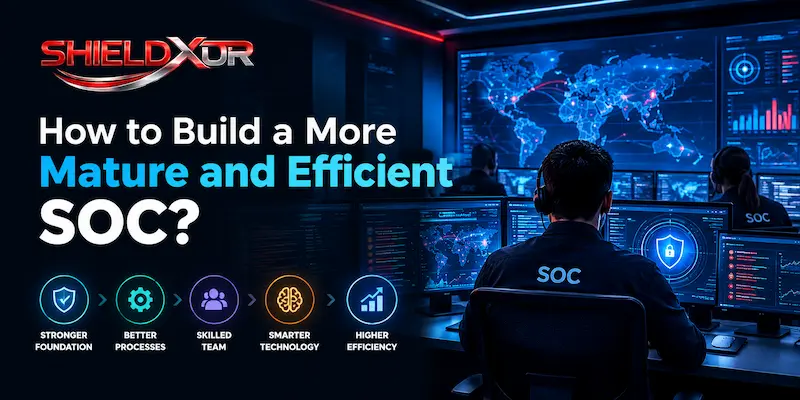
How to Build a More Mature and Efficient SOC?
|
S.No. |
Factors |
How? |
|
1. |
Implement Continuous Log Coverage & Engineering |
To remove monitoring blind spots across endpoints, networks, and cloud assets, audit data pipelines on a regular basis. |
|
2. |
Adopt Risk-Based Detection & Continuous SIEM Tuning |
To retain actionable detection rules, give priority to high-impact alerts while vigorously reducing false positives. |
|
3. |
Integrate Orchestration & Automated Playbooks (SOAR) |
To speed up containment and save up analyst bandwidth, automate repetitive triage and enrichment processes. |
|
4. |
Establish Proactive Threat Hunting & Threat Intel Programs |
To capture elusive attackers before alerts go out, ingest threat intelligence and carry out hypothesis-driven hunts. |
|
5. |
Invest in Continuous Skill Development & Adversary Simulation |
To improve team readiness against changing tactics, use tabletop exercises and purple teaming. |
Standardizing Incident Response Playbooks
The following are some standardizing incident response playbooks:
a) Align Content to Recognized Security Frameworks: To guarantee uniform, compliant response procedures, ground processes in NIST or SANS standards.
b) Establish Unified Decision Logic and Thresholds: To eliminate uncertainty during high-stress triage, clearly define severity matrices and escalation triggers.
c) Embed Step-by-Step Technical Instructions: Give analysts accurate terminal instructions and query templates so they can run confinement consistently.
d) Integrate SOAR Automation Hooks: To expedite enrichment, isolation, and ticket changes, incorporate automated activities straight into playbooks.
e) Schedule Continuous Testing and Version Control: To maintain response procedures up to date, conduct frequent tabletop drills and update playbooks following incidents.
Best Practices to Prevent Recurring SOC Mistakes
The following are the best practices to prevent recurring SOC mistakes:
1. Implement Continuous Log Quality Audits: Automate log pipeline inspections to quickly identify blind spots and malfunctioning ingestion streams.
2. Establish a Systematic SIEM Tuning Cadence: To reduce false positives and improve correlation thresholds, do weekly rule reviews.
3. Integrate SOAR for Repetitive Triage: Automated playbooks should handle host isolation, IP lookups, and routine enrichment.
4. Conduct Mandatory Post-Incident Reviews (Blameless Post-Mortems): To continuously improve defenses, record operational gaps and underlying causes following each incident.
5. Run Regular Purple Team Exercises & Adversary Simulations: To verify detections and hone analyst skills, test SOC readiness against actual TTPs.
Conclusion: Turning SOC Mistakes into Security Improvements
Now that we have talked about the Top 10 Common SOC Mistakes, you might want to get your hands on a dedicated cybersecurity solution from a reliable source. For that, you can go for ShieldXDR, a dedicated threat detection and response tool offered by Craw Security.
ShieldXDR can help businesses by automatically detecting any vulnerabilities in their networks and systems to alert users and respond to cyber threats in time to deal with unwanted data & financial losses. What are you waiting for? Contact, Now!
Frequently Asked Questions
About Top 10 Common SOC Mistakes
1. What are the most common mistakes made by SOC teams?
The following are the most common mistakes made by SOC teams:
a) Inadequate Log Collection & Blind Spots,
b) Failing to Tune SIEM Rules (Alert Fatigue),
c) Over-Reliance on Signature-Based Detections,
d) Lack of Automation & SOAR Integration, and
e) Siloed Communication & Poor Incident Documentation.
2. Why is alert prioritization important in a Security Operations Center?
Alert prioritization is important in a SOC for the following reasons:
a) Mitigates Critical Alert Fatigue,
b) Accelerates Mean Time to Respond (MTTR),
c) Optimizes SOC Bandwidth & Resource Allocation,
d) Prevents Severe Threat Oversight, and
e) Improves SLA Compliance & Risk Reduction.
3. How does poor SIEM tuning affect SOC performance?
Poor SIEM tuning affects SOC performance in the following ways:
a) Triggers Severe Alert Fatigue,
b) Inflates Mean Time to Detect and Respond (MTTD/MTTR),
c) Distorts Metrics and Strategic Decision-Making,
d) Accelerates Analyst Burnout and Turnover, and
e) Wastes Storage and Compute Resources.
4. What happens when threat intelligence is not integrated into SOC operations?
The following things happen when threat intelligence is not integrated into SOC operations:
a) Slower Threat Context & Detection (Blind Triage),
b) Delayed Identification of Adversary TTPs,
c) Inability to Proactively Block Known Bad Infrastructure,
d) Inefficient Alert Prioritization & False Positives, and
e) Reactive Defense Posture.
5. Why is proper incident documentation critical for cybersecurity?
Proper incident documentation is critical for cybersecurity for the following reasons:
a) Ensures Smooth Hand-Offs & Continuity,
b) Facilitates Post-Mortems & Root-Cause Analysis,
c) Satisfies Regulatory & Legal Compliance,
d) Enriches Threat Intelligence & SIEM Tuning, and
e) Establishes Clear Accountability & Metrics.
6. How can delayed incident escalation increase security risks?
Delayed incident escalation can increase security risks in the following ways:
a) Extends Adversary Dwell Time,
b) Facilitates Unchecked Lateral Movement,
c) Increases Risk of Data Exfiltration & Destruction,
d) Inflates Financial & Remediation Costs,
e) Complicates Forensics & Incident Reconstruction.
7. What are the risks of inadequate log collection and retention?
The following are the risks of inadequate log collection and retention:
a) Creates Critical Security Blind Spots,
b) Complicates Post-Incident Forensics,
c) Conceals Long-Dwell Adversaries,
d) Incurs Severe Compliance & Legal Fines, and
e) Hinders Effective Threat Hunting.
8. Why is communication between SOC analysts and other teams important?
Communication between SOC analysts and other teams is important for the following reasons:
a) Accelerates Incident Response and Containment,
b) Reduces Operational Friction and Disruption,
c) Enhances Threat Context and Technical Accuracy,
d) Ensures Legal, Compliance, and Executive Alignment, and
e) Drives Continuous Security Improvement.
9. How often should SOC teams conduct training and incident response drills?
SOC teams should have enterprise-wide tabletop drills every two years, hands-on purple team exercises every three months, and ongoing skills training every week or every two weeks.
10. Which metrics should be used to measure SOC effectiveness and maturity?
The following metrics should be used to measure SOC effectiveness and maturity:
a) Detection & Response Timelines (MTTD, MTTR, MTTI),
b) Alert Signal-to-Noise & False Positive Rates,
c) Coverage of Threat Frameworks (MITRE ATT&CK Mapping),
d) Threat Hunting Yield & Novel Detections, and
e) Incidents Escalated vs. Automated Triage (SOAR Efficacy).