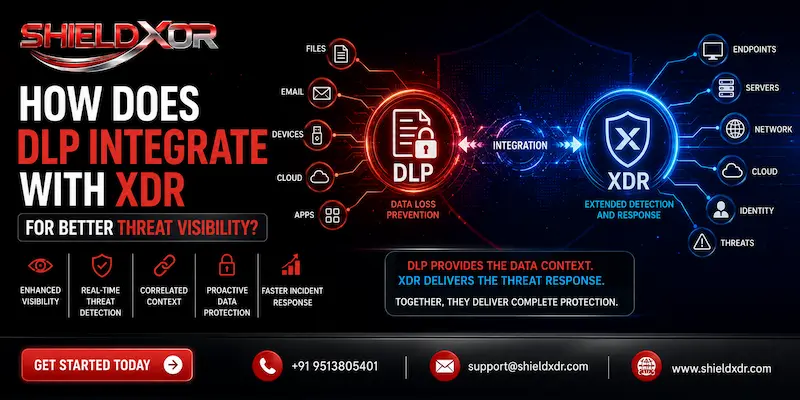
Do you know what kind of benefits Data Loss Prevention (DLP) can offer to the users working in the IT Industry? If not, then you are at the right place. Here, we will talk about DLP and related features in detail.
Moreover, we will introduce you to a reliable XDR solution offered by a reputable VAPT service provider. What are we waiting for? Let’s get straight to the topic!
What Is Data Loss Prevention (DLP)?
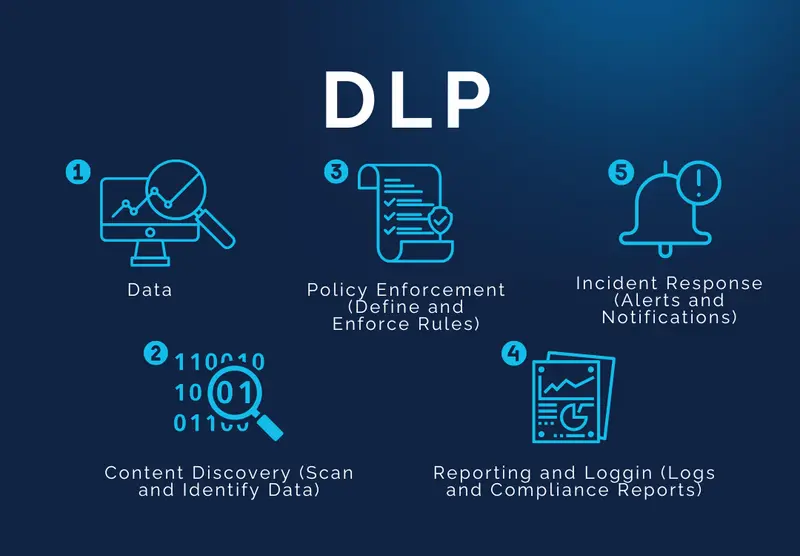
Data Loss Prevention (DLP) encompasses a broad cybersecurity strategy and a collection of tools aimed at identifying, tracking, and stopping sensitive data from being transmitted or exfiltrated without authorization beyond corporate boundaries.
DLP systems recognize sensitive information, including intellectual property, financial data, and personal health records, across networks, cloud environments, and physical endpoints through the use of deep content inspection and contextual analysis.
It ultimately enforces stringent security policies in real time to prevent accidental leaks or malicious theft, thereby ensuring adherence to data privacy regulations. Let’s talk about what Data Loss Prevention (DLP) is and related benefits in the IT Industry!
What Is Extended Detection and Response (XDR)?
Extended Detection and Response (XDR) is a unified cybersecurity solution that automatically gathers, correlates, and analyzes security telemetry from multiple layers, including endpoints, networks, cloud workloads, email, and identity systems, into a single interface.
It offers security teams unified visibility, accelerated threat hunting, and automated multi-domain response capabilities to counteract complex attacks before they inflict operational damage by dismantling conventional security silos.
Why Organizations Need DLP and XDR Integration?
|
S.No. |
Factors |
Why? |
|
1. |
Prioritizes Threats Based on Data Value |
Raises alerts according to how sensitive the targeted data is, instead of according to a generic assessment of threat severity. |
|
2. |
Stops Data Exfiltration in Real Time |
Immediately activates system containment upon detection of an unauthorized transfer of sensitive data. |
|
3. |
Provides Unified Visibility Across the Kill Chain |
Links the initial points of unauthorized access directly with subsequent efforts to retrieve and duplicate data. |
|
4. |
Supercharges Insider Threat Detection |
Combines unusual user behavior with sensitive file interactions to identify compromised accounts or rogue employees. |
|
5. |
Simplifies Regulatory Compliance and Audits |
Produces consolidated, audit-ready reports that connect ongoing security incidents to breaches of data protection policies. |
Key Components of DLP and XDR Integration
The following are some key components of DLP and XDR integration:
1. Cross-Layer Telemetry Collector: Consolidates logs of data transfers, events at endpoints, and network traffic into one uninterrupted stream.
2. Data-Contextualized Analytics Engine: Associates security alerts with data sensitivity tags to assess the actual business risk of an event.
3. Automated Multi-Domain Playbooks: Immediately set off coordinated defenses such as isolating a device and revoking file access the instant a leak happens.
4. Identity and Behavioral Profiling: Watches user behavior to detect compromised credentials or insider threats through unusual file access.
5. Unified Incident Management Console: Consolidates data-loss incidents and system threat alerts into one streamlined dashboard for quick triage.
How Does DLP Integrate with XDR?
DLP integrates with XDR in the following ways:
● Unified Telemetry Ingestion: Directly integrates feeds of endpoint data tracking and network traffic logs into a central XDR analytics pipeline.
● Data-Aware Correlation: Associates specific malware behaviors or system compromises with the data classification tags of accessed files.
● Contextual Alert Prioritization: Raises a low-level network alert to the status of a critical incident if it involves high-value intellectual property.
● Automated Multi-Domain Response: When exfiltration is detected, it simultaneously disconnects a compromised device and revokes cloud document sharing.
● Streamlined Incident Lifecycle Management: Integrates distinct threat tracking and compliance logging into a single automated timeline, spanning from detection to audit.
How does DLP enhance XDR Threat Visibility?
|
S.No. |
Factors |
How? |
|
1. |
Bridges the "Context Gap" for Analysts |
Includes data classification tags on system alerts, indicating to investigators precisely which sensitive files are endangered. |
|
2. |
Exposes Stealthy Data Exfiltration Paths |
Reveals concealed leak channels such as cloud synchronization, personal email, or USB transfers within the primary security timeline. |
|
3. |
Supercharges Insider Threat Detection |
Connect abnormal user actions with access to sensitive data in order to identify rogue employees or compromised credentials. |
|
4. |
Correlates Low-Severity Alerts into Major Incidents |
Consider a sequence of small network incidents a serious infringement when they are aimed at valuable intellectual property. |
|
5. |
Tracks the Complete Data Lineage |
Tracks the complete lifecycle of sensitive data, including its creation, alteration, and final transfer. |
How do DLP and XDR Improve Incident Response?
DLP and XDR improve incident response in the following ways:
a) Drastically Reduces Triage Time: Gives priority to incidents by providing an immediate indication of whether a compromised device holds sensitive corporate information.
b) Enables Instant Operational Containment: Simultaneously isolates compromised host machines and revokes active cloud-sharing permissions automatically.
c) Provides Complete Kill-Chain Visibility: Links the original means of penetration with the exact files aimed at illicit transfer.
d) Eliminates Blind Spots in Exfiltration: Oversees and prohibits data exports without authorization across endpoints, personal email, and cloud storage.
e) Automates Regulatory and Legal Evidence Collection: Records ongoing forensic particulars of data management amid an incident for swift compliance reporting.
Benefits of Integrating DLP with XDR
The following are the benefits of integrating DLP with XDR:
1. Data-Contextualized Prioritization: Raises alerts according to the real value and categorization of the targeted data.
2. Coordinated, Real-Time Containment: Immediately isolates compromised hosts and revokes file permissions to halt active leaks.
3. Holistic Attack Path Visibility: Tracks the entire lifecycle of a breach, connecting the initial intrusion to the targeted data.
4. Superior Insider Threat Detection: Identifies compromised accounts and rogue employees by matching user anomalies with data-access events.
5. Streamlined Compliance and Audit Readiness: Regulatory reporting is simplified through the combination of automated incident timelines and data loss forensics.
Common Use Cases of DLP and XDR Integration
|
S.No. |
Cases |
What? |
|
1. |
Detecting and Stopping Ransomware Exfiltration |
Prevent encryption attacks by identifying the collection of large volumes of data and stopping data exfiltration prior to the ransoming of files. |
|
2. |
Neutralizing Insider Threats and Account Takeovers |
Identify compromised credentials or rogue employees by associating unusual login locations with access to sensitive data. |
|
3. |
Securing Remote and Cloud-Based Workforces |
Oversees and prevents data transfers that are not authorized on personal devices that are not managed and on external cloud applications. |
Challenges of Integrating DLP with XDR
The following are the challenges of integrating DLP with XDR:
● High Volume of False Positives: XDR analytics are inundated with benign business transfers, leading to alert fatigue among security operations teams.
● Data Format and Schema Incompatibility: Involves intricate analysis to translate proprietary DLP content tags into standard XDR threat telemetry frameworks.
● Performance Overhead on Endpoints: Simultaneously operates intensive threat detection and deep data-scanning engines, putting a strain on the device's CPU and memory.
● Privacy and Regulatory Constraints: Taking the risk of compliance violations by consolidating protected user data in security logs that security analysts can see.
● Operational Silos and Alert Ownership: Cause uncertainty regarding the proper team (data compliance or cybersecurity operations) for an integrated incident.
Best Practices for Successful DLP and XDR Integration
The following are the best practices for successful DLP and XDR integration:
a) Establish a Unified Data Classification Schema: Ensure consistent threat prioritization and risk evaluation by aligning data tags across both platforms.
b) Map DLP Triggers to Threat Frameworks: Connect data-loss notifications with frameworks such as MITRE ATT&CK to instantly recognize adversarial exfiltration strategies.
c) Deploy Phase-Based Automation Playbooks: Begin with the enhancement of automated alerts and the implementation of small limitations before advancing to complete endpoint isolation.
d) Optimize Endpoint Agent Performance: Consolidate security personnel and stagger intensive content scans to avert system degradation on user devices.
e) Establish Joint Incident Governance: Clearly specify whether it is the security operations team or the compliance team that owns and resolves integrated alerts.
Conclusion: Why Do DLP and XDR Together Deliver Better Threat Visibility?
Now that we have talked about what Data Loss Prevention (DLP) is, you might want to get your hands on a dedicated XDR solution from a reliable source. For that, you can go for ShieldXDR, a dedicated threat detection and response tool offered by Craw Security.
ShieldXDR can automatically detect cyber threats and any suspicious activity over your networks & systems, while dealing with them with ease. Thus, you will be able to protect yourself against future threats. What are you waiting for? Contact, Now!
Frequently Asked Questions
About Data Loss Prevention (DLP)
1. What is DLP, and how does it work with XDR?
Data Loss Prevention (DLP) safeguards sensitive information from unauthorized transmission and collaborates with Extended Detection and Response (XDR) by providing data-context logs that link security alerts to actual asset value for swift, coordinated incident containment.
2. How does DLP integration improve threat visibility in XDR?
DLP integration improves threat visibility in XDR in the following ways:
a) Bridges the "Context Gap" for Analysts,
b) Exposes Stealthy Exfiltration Channels,
c) Correlates Low-Severity Events into Critical Incidents,
d) Speeds Up Insider Threat Detection, and
e) Maps the Entire Data Lineage.
3. What are the benefits of integrating DLP with XDR?
The following are the benefits of integrating DLP with XDR:
a) Data-Contextualized Prioritization,
b) Coordinated, Automated Containment,
c) Superior Insider Threat Detection,
d) Reduced Alert Fatigue, and
e) Simplified Compliance and Auditing.
4. Can DLP and XDR help prevent insider threats?
Yes, they avert insider threats by combining the user behavioral anomaly detection of XDR with the sensitive data monitoring of DLP, allowing for the immediate identification and blocking of rogue employees or compromised accounts attempting to exfiltrate files.
5. How does XDR use DLP data during incident investigations?
XDR uses DLP data during incident investigations in the following ways:
a) Instantly Quantifies Incident Severity,
b) Maps the Data Exfiltration Path,
c) Traces Attackers' Reconnaissance and Staging,
d) Pinpoints Compromised Accounts and Hosts, and
e) Enriches IOCs with Data-Aware Context.
6. Which types of data can DLP monitor and protect within an XDR environment?
DLP can monitor and protect the following types of data within an XDR environment:
a) Personally Identifiable Information (PII) and Protected Health Information (PHI),
b) Intellectual Property (IP) and Source Code,
c) Corporate Financials and Strategic Documents,
d) Regulated Industry Datasets, and
e) Unstructured Cloud and Collaboration Data.
7. What are the common challenges of integrating DLP with XDR?
The following are the common challenges of integrating DLP with XDR:
a) High Volume of False Positives,
b) Data Format and Schema Incompatibility,
c) Performance Overhead on Endpoints,
d) Privacy and Regulatory Constraints, and
e) Operational Silos and Alert Ownership.
8. Which industries benefit the most from DLP and XDR integration?
The following industries benefit the most from DLP and XDR integration:
a) Healthcare and Life Sciences,
b) Banking and Financial Services,
c) Defense and Government Contracting,
d) Technology and Software Engineering, and
e) Critical Infrastructure and Manufacturing.
9. What are the best practices for implementing DLP and XDR together?
The following are the best practices for implementing DLP and XDR together:
a) Establish a Unified Data Classification Schema,
b) Map DLP Alerts directly to Threat Frameworks,
c) Deploy Phase-Based, Progressive Automation,
d) Optimize Endpoint Agents to Prevent Bloat, and
e) Create a Shared Incident Governance Model.
10. How does DLP and XDR integration improve incident response and compliance?
DLP and XDR integration improves incident response and compliance in the following ways:
a) Triggers Automated, Context-Aware Containment,
b) Radically Decreases Mean Time to Resolution (MTTR),
c) Ensures Exact Scope Assessment for Regulatory Reporting,
d) Eliminates Security and Compliance Team Silos, and
e) Generates Tamper-Proof, Audit-Ready Timelines.